About the Center
The Abdorrahman Boroumand Center for Human Rights in Iran (The Center) is a non-governmental non-profit organization dedicated to the promotion of human rights and democracy in Iran. The Center, formerly the Abdorrahman Boroumand Foundation, was co-founded by Ladan and Roya Boroumand in 2001. You will still see our old name in certain locations, including older reports and quoted sources.
The Center is an independent organization with no political affiliation. It is named in memory of Dr. Abdorrahman Boroumand, an Iranian lawyer and pro-democracy activist who was assassinated by the agents of the Islamic Republic of Iran in Paris on April 18, 1991. The Center believes that promoting human rights awareness through education and the dissemination of information is a necessary prerequisite for the establishment of a stable democracy in Iran. ABC is committed to the values enshrined in the Universal Declaration of Human Rights of 1948 and in other internationally recognized human rights instruments. Taking as a starting point the fundamental equality of all human beings, the Center seeks toensure that human rights in Iran are promoted and protected without discrimination, whether it be on the basis of one's gender, race, religion, ethnicity, or national origin. Guided by the belief that unremedied human rights violations are a major obstacle to the establishment of a stable democracy, the Center is committed to the right of all victims of human rights abuses to justice and public recognition.
The Center seeks to ensure that human rights in Iran are promoted and protected without discrimination.
Based on the foregoing principles, the Center adopts as its mandate the promotion of public awareness of issues concerning democracy and human rights in Iran. Through its programs of research, documentation, publications, and outreach, the Center hopes to help restore the dignity of Iran's countless victims of human rights violations.
The Center’s signature project, Omid: A Memorial in Defense of Human Rights, is an electronic database that documents and narrates the stories of individuals deprived of their right to life by the Islamic Republic of Iran. In addition to the ongoing work on the Omid Memorial, ABC has established an online library that offers extensive research, reports, and translations of literature related to human rights, democracy, and transitional justice. This library serves as a valuable resource for the public and experts focusing on Iran, as well as on human rights and democracy issues. Over the years, ABC has organized numerous campaigns and implemented special projects to address the ongoing persecution of various segments of Iranian society and the egregious abuse of the death penalty. The bilingual nature (English and Persian) of ABC’s work aligns with its mission: informing Iranians about their rights and defending them, while also informing the world about state-perpetrated crimes in Iran.
ABC's achievements are made possible by the generous support of numerous institutions and individuals. We are proud to present a summary overview of our more than two decades of work, along with its associated operating and program fund allocations.
***
Funding and Financial Overview
The Abdorrahman Boroumand Center (Foundation) for Human Rights began its work in 2001 with two volunteers—its founders, Ladan and Roya Boroumand. For six years, the Boroumands worked from a home office, collaborating with volunteers and part-time consultants before securing a sublet office space. The Human Rights Data Analysis Group (then part of AAAS) donated the Center’s first database along with technical support.
Charity Navigator has awarded the Abdorrahman Boroumand Center a Four-Star rating, with a score of 96%, reflecting its adherence to good governance and financial accountability.
Sources of Support (2001 to 2024)
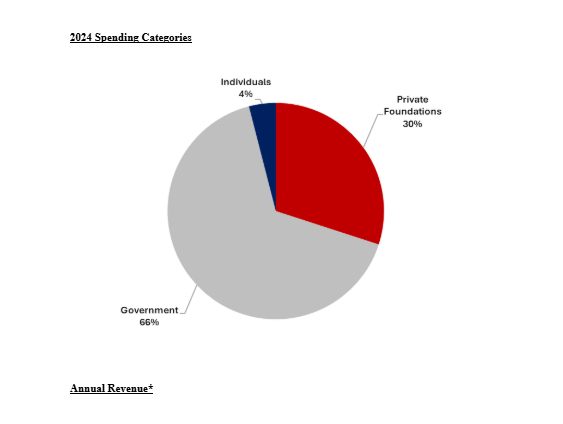
The Center’s work is enabled through the generous support of a diverse array of public and private funders – from charitable foundations to individual donors.
-
Since 2002, it has received funding from 10 private North American and European foundations (68%).
-
Since 2015, it has also received support for projects related to its core program and designed by it from three governments (22%).
-
Since 2006, it has received donations from 3,001 individual donors (10%.) Among them, 1,584 made donations below $100 and 533 donated between $250 and $500.
Over the years, multiple generations of political refugees of different backgrounds, religion, ethnicity and political beliefs have collaborated with the Center as volunteers, staff members and consultants. Between 2001 and 2024, the Center has employed:
-
22 full-time staff (with salaries and benefits comprising 45% of the budget)
-
204 contractors, including full-time and part-time researchers, social media officers, translators, IT specialists, accountant etc. (38%)
The remuneration of the Executive Director and the Research Director, the Center’s co-founders, accounts for 10% of the organization’s budget.
The Abdorrahman Boroumand Center undergoes an annual independent audit of its program's income and expenditures. This practice aligns with the organization's commitment to financial transparency and accountability.
Annual Revenue*
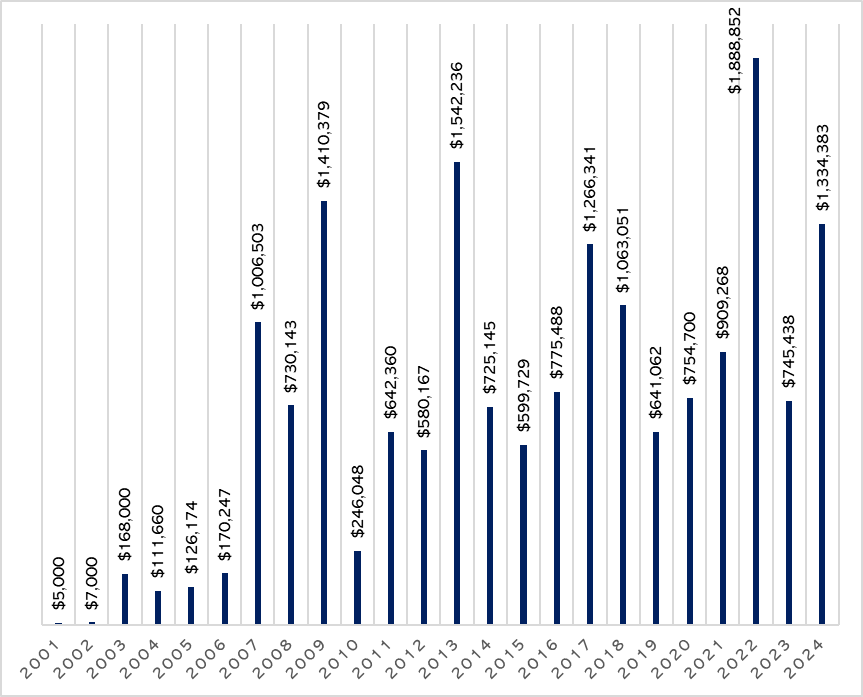
*The Center uses an accrual-based accounting system. Some years therefore may show higher revenue figures because multi-year grants are reflected in the year they were awarded.
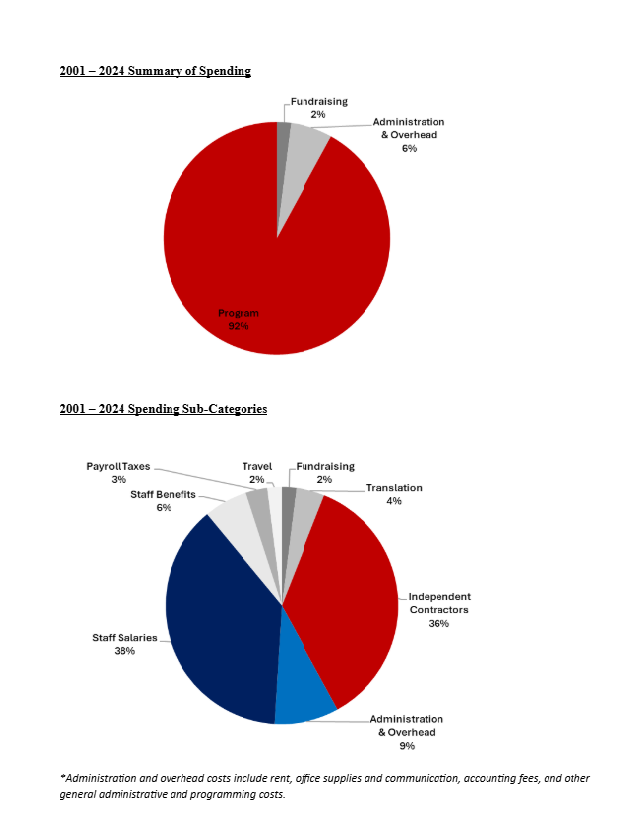
The total amount ABC has spent through 2024 is $15,868,348.
Highlights of Program Achievements and Milestones
(2001–2024)
Omid: a Memorial in Defense of Human Rights
● From 2006 to 2024, the Center published more than 27,000 profiles of individuals whose right to life was violated by the Islamic Republic of Iran or its proxies. These profiles—available in both English and Farsi are based on extensive research of newspaper archives and published sources. At least 11,605 profiles are built on thorough investigations using written and audiovisual sources, official statements, media and social media, and interviews.
● Gathered from multiple sources, data for victims’ profiles is entered into the Center’s database, matched, judged and published. The Center strives to update cases as new information emerges.
● The Center's researchers have conducted at least 1,436 comprehensive semi-structured interviews with victims’ families, friends, and informed sources, and transcribed several thousand hours of audio recordings.
● Since making the Omid Memorial accessible to the public in 2006, the Center has received at least 5,998 unsolicited electronic forms and emails on victims profiled in the Omid Memorial from victims' families, friends, and other informed sources.
● Several thousand researched cases are still awaiting processing, editing, or translation.
Data Collection and Archiving:
-
Researched, organized and archived data on at least:
- 22,667 executions
-
1,088 extrajudicial killings
-
72 cases of death threats and failed assassination attempts
-
8,509 individuals killed in clashes with security forces
-
846 security personnel killed in clashes
-
19,348 cases of students persecuted by the judiciary and universities for activism, protests, or appearance (2000-2018).
Human Rights and Democracy Library
Research, reports, archiving, translations and publications:
-
Collected and archived a vast range of materials, including Iranian newspapers dating back to 1979 and made accessible in its online library an archive of 2085 reports on the situation of human rights in Iran by the United Nations and international human rights organizations dating back to1980. A valuable resource for studying the history of state violence in the Islamic Republic of Iran.
-
Translated into Farsi and published 27 of the United Nations' human rights instruments including Human Rights in the Administration of Justice.
-
Created a collection related to truth and reconciliation commissions in various countries and translated it.
-
Carried out scores of interviews and created witness and victims statements to be used in reports and translated and published at least 43 testimonies and 173 laws, official statements, books, charters, and activist statements (including those from women and students).
-
Researched and translated into English all acts in the Islamic Republic’s penal code that carry the death penalty (218) or flogging (149).
-
Published 145 comprehensive newsletters and 18 reports in two languages including two major reports on the Islamic Republic’s crimes against humanity:
-
The Massacre of Political Prisoners in Iran, 1988, Report Of An Inquiry
-
AMIA Bombing: The Islamic Republic’s Forgotten Crime Against Humanity
Reports and newsletters on the Islamic Republic’s inception and on its flawed electoral and judicial systems among other publications:
-
Neither Free Nor Fair, Elections in the Islamic Republic of Iran
-
Iran Judges: A Selection Process that Paves the Way for Injustice
-
The Clash of Ayatollahs: A Religious Challenge to the Monopoly on Power by the Clergy
-
The Cost of Defending the Rule of Law (timeline on the persecution of lawyers)
-
Qassameh, a deadly symptom of Iran’s dysfunctional justice system
-
Internal Report of the judiciary on the Violations of Procedure and Due Process by Iranian Judges (translation by the Boroumand Center)
-
Thirty Five Years of War on Drugs: a Human Cost Iran Should Not Take Pride In
-
Iran Must Close Down The 36-Year-Old Islamic Revolutionary Courts
-
Reports on contemporary issues such as Executions, the spread of COVID-19 in prisons, and protests:
-
Women, Life, Freedom: Victims Fight for Accountability Amid Repression
-
Outsiders: Multifaceted violence against Baháʼís in the Islamic Republic of Iran
-
Proven Without Certainty: How Judges Sentence Defendants to Death in Iran
-
After a Bloody May: The World Must Challenge Iran’s Escalating War on Dissent
-
Jamshid Sharmahd, the Latest Victim of Iran's Unlawful Campaign Against Dissent
-
COVID-19 Fear in Iran's Prisons: Iran Must Do More to Protect Prisoners, April and September 2020
-
A Sample of the Center’s Newsletters:
-
The 1983 Collective Punishment of Kurds: The Forgotten Stories
-
The July 11, 1999, Protests at Tabriz University: Repression and Oblivion
-
Saleh Shariati: Juvenile Sentenced to Death on No Convincing Evidence
-
Fear and Silence: 30th Anniversary of the US Embassy Bombing in Beirut
-
Authorization Denied: The high cost of the public expression of dissent in Iran
-
Archived, and/or translated into Persian and published and disseminated crucial essays on democracy, human rights, religious freedom and tolerance, death penalty, and women’s rights:
- Voltaire : Treatise on Tolerance
- Baroch Spinoza: Freedom of Thought and Freedom of Expression Under A Free Government
- Cass R. Sunstein: Why Societies Need Dissent
- Hannah Arendt: Personal Responsibility Under Dictatorship
- Vaclav Havel: The Power of the Powerless and Two Other Essays
- Alexander Hamilton & James Madison: Federalist Papers 9, 10, 39, 51,69
- Jean-Marie Carbasse: Death Penalty, a Short History
- C. Bunch, E. Friedman, E. Stamatopoulou: Women’s Rights Are Human Rights
- Geoffrey Robertson: The Story of Human Rights
Raising Awareness
-
Led several anti-death penalty campaigns, including efforts to stop child executions and secure the release of political prisoners during the pandemic. Contributed to the work and publications of the World Coalition Against the Death Penalty.
-
Presented its findings and methodology in several prestigious universities, including Harvard and Oxford. It has organized a major seminar in Oxford on transitional justice, bringing together experts and victims to explore possible paths to accountability.
-
Organized an exhibit displayed at nine universities and produced a documentary on student persecution.
-
Produced 103 short films and animations, as well as documentaries, including video interviews such as:
- Behnud Shojaei: Sentenced at Age 17
- Iran and the CRC: Justifying the Unjustified
- Do They Really Cut Off Your Hand for Stealing in Iran?
- Reyhaneh Jabbari: Justice Denied, Dignity Under Assault
- Visualized data on child executions, extrajudicial killings and threats and protest killings interactive maps, and floggings.
International Advocacy
Since 2014, the Center has been active in international fora and become a trusted source of information for the international community. It has been an active member of coalitions of NGOs working on Iran or focused on the death penalty. It has contributed to efforts aimed at holding the Islamic Republic accountable at the United Nations and pressing its leaders for much needed changes. These efforts have included:
-
Drawing attention to the high number of executions and the gravely flawed judicial process in Iran, Iran’s costly and failed war on drugs and successfully advocating for a freezing of Europe’s support to it, the cases of individuals at risk of executions, including children, the need for structural changes, and extrajudicial executions, crackdown against protesters, and Iran’s efforts to undermine universal human rights among other issues.
-
Advocating in support of the UN resolutions on the situation of human rights in Iran and the renewal of the mandate of the UN Special Rapporteur on Iran.
-
Drawing attention to discriminatory laws and violence in their implementation and advocating on the expulsion of Iran from the Commission on the Status of Women.
-
Advocating for the establishment of an independent Fact-Finding Mission on Iran in 2022 and the renewal of its mandate.
-
In 2019 ABC’s research, and legal analysis on the 1988 prison massacre was used by victims to draft a complaint leading to the arrest and conviction of a prison assistant prosecutor in Sweden.