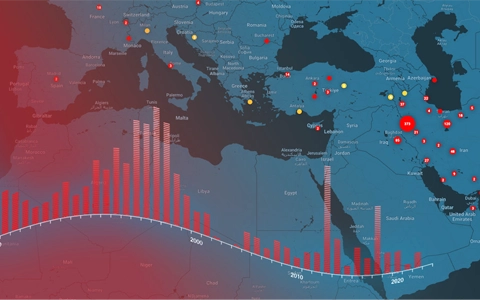
Interactive map documenting the systematic and arbitrary killing of protesters in Iran since 1979.

Right to Protest in International Law
Iran has ratified the International Covenant on Civil and Political Rights (ICCPR)—which guarantees the rights to peaceful assembly, free expression, and life—but it routinely violates these rights. The 1979 Constitution of Iran nominally guarantees a broad set of rights, including equality before the law, the right to life, freedom of expression, association, and peaceful assembly, access to legal counsel, and protection from arbitrary detention and torture. However, many of these rights are undermined by vague qualifications requiring conformity with undefined “Islamic criteria” or prohibiting anything deemed contrary to “the fundamental principles of Islam.” These terms, which appear in key constitutional articles, are used to restrict fundamental freedoms. Protests on subjects deemed to “disturb the foundations of Islam” are effectively banned, and individuals or groups not aligned with the Islamic Republic’s ideology are barred from legally exercising their right to peaceful assembly.
The right to protest is firmly grounded in a number of distinct but interconnected fundamental human rights, including the right to freedom of expression, to freedom of association and assembly, and to participate in public affairs. In its General Comment No. 37, the UN Human Rights Committee defines how protests can take many forms, “regardless of the location –outdoors, indoors; in public and private spaces; or a combination thereof–and covers various forms of assembly, including demonstrations, protests, meetings, processions, rallies, sit-ins, candlelit vigils and flash-mobs, whether they are stationary or mobile”. Furthermore, the UNHRC explains the obligations of law enforcement authorities during peaceful assemblies, emphasizing their primary duty to facilitate and protect—not suppress—the right of individuals to gather and express themselves peacefully. Law enforcement officials are required to act as protectors of fundamental rights, ensuring that assemblies can proceed without fear, intimidation, or retaliation. This includes protecting participants from violence or interference by third parties, including counter-demonstrators or hostile actors. The use of force by law enforcement during assemblies must always be a last resort and guided by principles of legality, necessity, proportionality, and accountability.
Dr. Mohsen Sohrabi, who treated injured protesters in their homes in Sanandaj during the 2022 Woman, Life, Freedom protests, recounts his experience:
On the night of October 29, 2022, the hospital where one of the injured protestors from Sanandaj was admitted became extremely crowded…. As tensions escalated, people gathered in front of Kosar Hospital, growing so numerous that they couldn't be contained. Security forces resorted to gunfire, leading to injuries. At the University of Medical Sciences dormitory, students protested, only to be met with violence from repressive forces, resulting in injuries, including one student nearly losing an eye.... I remained in constant communication with the injured students and assisted in their medical treatment….The next day, I observed from a distance as students behind the barred university doors chanted slogans while undercover and special forces intermittently attacked, firing tear gas. People gathered on the street, causing traffic disruptions, and joining the protests. It was the largest gathering at the University of Medical Sciences, plunging the entire campus into chaos. While the agents didn't enter the university, they fired upon students from outside, using shotguns and tear gas.
Read Dr. Sohrabi’s full testimony here.
Victims of Iran’s Bloody Crackdown of Protests
The Abdorrahman Boroumand Center has documented over 1,567 protest-related killings between 1979 to the present, but the actual number is much higher as many families do not report the death of their loved ones for fear or retaliation. Individuals have been summarily executed, arbitrarily killed, and disappeared. Families seeking the truth or justice face threats, harassment, and even prosecution and imprisonment if they persist. Omid Memorial dedicates a page to each victim to ensure they are not forgotten and to uphold their right to truth, accountability, and remedy. You can read more about the different protest victims in the Omid Memorial.