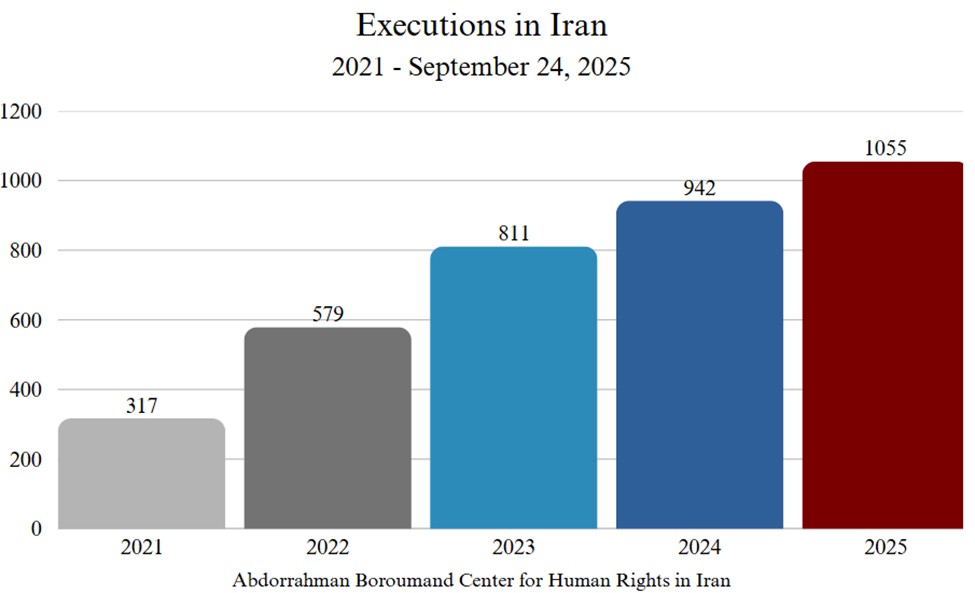
With 1,055 executions as of September 24, 2025, the Islamic Republic of Iran’s assault on the right to life in 2025 is a record high for the last three decades. Out of the 10 people who were executed for alleged espionage for Israel, 8 were killed during and after the June 13-25 war. For over four decades, Iran has met political crises and public unrest with waves of summary, arbitrary, and extrajudicial executions. Iran’s lawmakers legislate to facilitate crackdowns. They have expanded the death penalty to espionage for Israel and other hostile states in 2020 and now with a new bill passed on June 23rd. Iranian officials actively engage with the international community but recommendations to halt executions and respect human rights commitments fall on deaf ears. The Abdorrahman Boroumand Center for Human Rights in Iran (ABC) new report, One More Excuse to Kill: Espionage Weaponized in Iran’s Unrelenting Assault on the Right to Life, documents Iran’s exploitation of vague espionage laws to spread fear in society. The report includes statistics, case studies of four individuals executed with blatant due process violations on the alleged charge of espionage for Israel, a legal analysis of the espionage laws, and recommendations.
On June 25, Azad Shojaei, Edris Ali, and Rasul Ahmad Rasul, three Kurdish men who had been involved in the trade and smuggling of alcoholic beverages between Iraq and Iran, were secretly executed after being convicted on trumped-up charges. Their families were neither notified nor given their bodies. In September, father of two Babak Shahbazi, who had participated in the 2022 “Woman, Life, Freedom” protests, was executed after a sham trial that relied on a retracted coerced confession. These convictions were based on the 2020 law, which was used retroactively for the three Kurds. Since its inception, the Islamic Republic has codified repression and criminalized dissent with vaguely formulated laws open to interpretation and the banning of political parties and groups, which did not share its leaders’ vision of a theocratic state. The latest measure, the proposed June 2025 espionage bill, expands the definition of espionage to cover peaceful protests, journalism, and even the sharing of videos abroad. Ratification of this bill would give Iran’s authorities new legal instruments to execute perceived opponents, building on a long legacy of repression through fear. Iran’s pattern is unmistakable: when power feels threatened, the state represses dissent, strengthens national security laws, and executes its opponents and vulnerable individuals to spread fear. International condemnation has so far been ineffective. Authorities operate with impunity, confident that no meaningful political or economic consequences will follow. At the same time, they polish their image abroad—participating in human rights dialogues, engaging with the UN mechanisms, staging exhibits at the UN headquarters, and trying to obstruct accountability mechanisms such as the UN Fact-Finding Mission on Iran. But there is little in the way of implementation. Iran’s dismissal of all recommendations on the death penalty during its Universal Periodic Review underscores its disregard for international norms and people's lives. The international community’s failure to act decisively and effectively has left families traumatized and civil society under siege, while mechanisms to prevent atrocities are underfunded and overstretched. To break the cycle of repression, the report urges states to censure and penalize Iranian leaders, support victims’ families denied even the bodies of their loved ones, and press for genuine political openings—including transparent elections, pluralism, and equal participation. Without such measures, Iran’s execution frenzy will continue unchecked, making thousands of victims and deterring Iranians from claiming their right to public participation and the ability to change the country's harmful internal and foreign policies.
Read the full report here