
Testimony of Kosar Eftekhari
[The 2022 protests in Iran began in September that year after the death of Mahsa Amini in the custody of the morality police and quickly grew into a nationwide movement under the slogan “Woman, Life, Freedom” against the Islamic Republic]
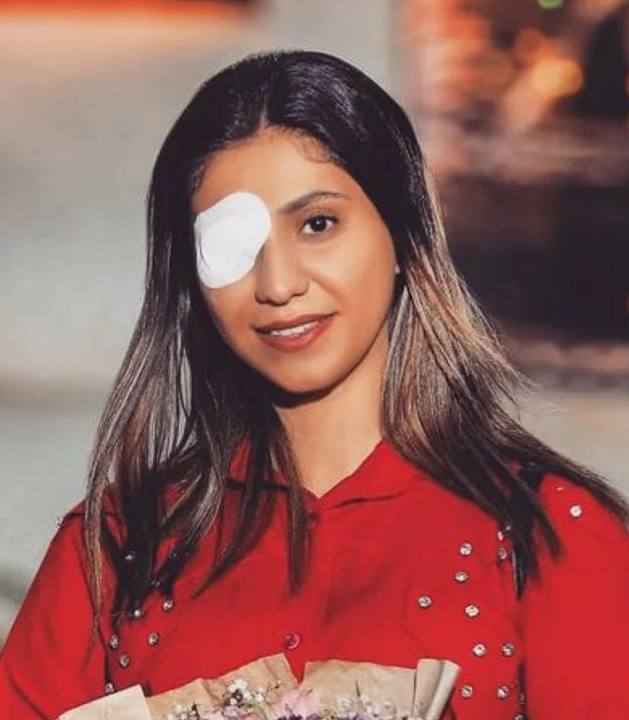
The name on my birth certificate is Kosar Eftekhari. I was born in Tabriz in 1999 and grew up in one of the suburbs of Tabriz called Mamaqan. I am very interested in theater and acting, so now the only thing that I do after losing an eye is practice theater.
I grew up in a very religious family. My father wanted to force the veil and praying on me. When I was in contact with some of my friends who were in Turkey or some relatives who lived in Canada and America, I saw the difference between our lifestyle and theirs, which is like the distance between the ground and the sky. From when I was only 10-12 years old, I hated this difference. In fact, because my grandfather was a religious jurist, my father also had a lot of prejudices deriving from his family environment and ignorance, and he imposed the veil on me. Of course, I was not upset with my father alone, because I realized that the problem is with the country in which I live. The problem is these Mullas (clerics). I always look at pictures from the Pahlavi era with sadness and say that I wish I lived during those times. Maybe if I had been there at that time, I would have been spared all the crying and nerve shattering pressure of my childhood and teenage years brought about by the mandatory veil and imposed Islam on the family. I knew from a young age that the main culprit was the situation of our country. Maybe if we were like our other relatives in Canada or America, my father would not be like this, and I would have a comfortable life and not be a depressed youth.
In the 2009 elections [The 2009 presidential election in Iran led to widespread protests. The protesters believed that the election had been rigged], my father was the head of Mir Hossein Mousavi's campaign[the defeated candidates of the election] headquarters in Mamaqan. For this reason, after the elections and following the protests that took place in those years – even though he himself was a supporter of the Islamic Republic – he was interrogated. For this reason, we were banned from entering our city, Mamaqan, meaning they did not allow us to enter our house and the city where we live for a week or ten days. They even took the birth certificates of my father and our family so that we could not vote. What they told us was that we were exiled. They didn't exile us to a specific city, in fact, they just banned us from Mamaqan. I could feel the stress, anger and terrible sadness that my father had. I said to myself, what did my father do? Why these interrogations? What does my father have to do with the country's protests? My father was only a campaign worker for one of the candidates. Why should all this tension be created for my family? And it was from that time on that this hatred for the Islamic republic took root in my heart.
In 2017, after turning 18 and getting accepted at Al Zahra University [public university exclusively for women] , I came to Tehran and lived independently. I was tired of living in Mamaqan. It was a city where all girls had to wear the chador: that is, a girl who does not wear a chador in Mamaqan is considered corrupt. There are no restaurants or cafes or places [in Mamaqan] where a girl can sit alone and no one will say anything about her. That's why, early on, my mind was set to stand on my own feet, not depend on my family, and [not] live in a small town.
Participation in the November 2017 and 2019 protests
[The December 2017 protests erupted in response to economic hardships, and the November 2019 protests broke out following the threefold increase in gasoline prices. Both waves of protests were brutally suppressed]
In 2017, when I came to Tehran, there were protests in Tehran, which I and some of my fellow students participated in by going to Enqelab Square. That year, though we saw people being grabbed, neither I nor any of my friends were detained. After the 2017 protests came the 2019 protests, when people took to the streets due to financial pressures, high prices, and especially the price of gasoline, which became very expensive. As a member of the community, I have always considered myself obligated – if I am dissatisfied with the conditions of the country, if I believe that Iran is ruled by a corrupt government, based on my conscience as a human being – to participate in street protests. That year, I was on Keshavarz Boulevard and saw how people were shot in front of my eyes, and several people fell to the ground.
Guidance Patrol Detention Center
In January/February 2020, before the spread of Covid, I was going from the Haqani metro to Tabi’at bridge. I was wearing a shawl and a winter hat that day. Not a single strand of my hair was out. My neck was fully covered with a scarf and a very large winter hat covered my head to my neck. I was also wearing a long and loose dark blue jacket. As soon as I came out of the Haqani metro, seven or eight women wearing chadors came at me. I was twenty years old then. They came at me as if they had caught a serial killer or someone very important. At first, I thought maybe they had mistaken me for someone else, although I knew in my heart that this is what they do. Before this, I had been grabbed by the Guidance patrol five or six times. They asked, “why do you wear a hat? This is Western clothing. Our country is Islamic and your clothing is not customary in our society.” I am not one to say "yes, yes, you are right." I said that my veil is completely Islamic, even my neck is not exposed. And I even said that my hijab with this jacket is better than your hijab that you wrapped around yourself. Then one of them asked me, “how long ago was it that you were in a demonstration?” When I [doubted her sanity] and said, "You must not be feeling well," they grabbed me and dragged me on the ground to the Guidance patrol van. Dragging people on the ground has become a Guidance patrol routine. When they took me inside the van, they told me that the car has a camera and everything I did would be recorded from that moment on. Since there was a camera, I removed my hat and shawl right there, when suddenly someone slapped me so hard that it felt like an electric shock! I had never been beaten like this, not even by my family; they hit me so hard that I screamed and yelled: “what right do you have to hit me?” They also covered my mouth with their hands, saying, “Don't make a sound, you took off your hijab, you’ll only have to do a few months in prison.”
After that, they took me to Vozara Street, Morality Security Police Center. They sat me down in a room there alone. The Guidance patrol had taken me there at least five or six times before. But I was never alone in that room. They would always bring groups of girls. Many of the girls generally express regret, crying and promising to [wear the veil properly], and their family would bring them [appropriate] clothes and take them away. But I never cried. They haven’t seen my tears and they never will.
Someone came and started to interrogate me. He asked, "Who are you in a relationship with?" "What right do you have to take off your hijab in a Guidance patrol car? No one has this right." I argued that if no one has done it before, then I am the first to do it. I told him, “When I am wearing appropriate clothing and you cause me stress for no reason and ruin my day, I will do the same [and ruin your day].” When I said this, he slapped me. I shouted again, “what right do you have to hit me?” “is there anyone here who hears my voice, to whom should I go for protectione…'' but he continued to beat me. Someone hit me in the middle of my forehead and kept telling me to be quiet. On my other side, his colleague was hitting me from behind. Someone with gloves grabbed my cheeks and pressed them, while saying, "Tell me ‘I've eaten shit [I regret].’” I almost cried, but I never cried in front of them. Finally, I told them:“this is who I am, this is what I wear, and it is completely Islamic.” They then said that I must go before the judge.
That night, I slept in the Vozara Detention Center. I was in solitary confinement in a small room, maybe ten meters. In the middle of the night, a bigshot came to my cell. Maybe he was a colonel, because he had the insignia [of a high ranking person] on his shoulder. He asked, "Are you Kosar Eftekhari?" I said yes. He said, “I want to talk to you.” I said, “I will listen, but if you want to talk to me like your colleagues did, it's better not to talk, it's better if I go before the judge.” He said, “no, I just want to talk.” Then he asked again, “are you in a relationship with someone?” I said, “what do you mean?” He said, very clearly, “I am asking, do you have a boyfriend?” I couldn't believe it, this man was maybe 50 years old, I'm sure he was at least over 40. When I said “no, I don't have a boyfriend,” he said very softly: "That's great, I like you very much, you have a very beautiful voice and face. If you are in a relationship with me, no one will have the right to look at you, and if you want, you can go out in the street in a top and shorts and dress however you want. No one would dare do anything about it!" I got up, shouted loudly and banged on the door, “come and take me out of here or I will kill myself.” The man got up and said, "Calm down, I was testing you. Tomorrow you will go before the judge, but know that the judge will not release a person who took off her hijab and was also in a protest. You will stay in prison for at least five or six years." I said “OK, I'm going to prison, at least let me sleep until tomorrow.” The man closed the door and left.
The next morning, a woman entered my room, kicked me in the back, and told me to get up. She took me inside the hall and handcuffed me. She tied one side of the handcuff to the chair. She slapped me and said: "a girl who doesn’t wear a hijab, the judge knows how to treat you." They kept me there for several hours, from 9 AM to 5 PM. In all this time – that is, since the day before – I hadn’t eaten any food. Even though there was a water cooler, they told me that they don't give water to girls who don’t wear hijab, so I drank water from the bathroom sink.
Around five o'clock, another man came and talked to me. He told me that he himself was against this behavior, he said that his wife's clothing is worse than mine, he knows that I am innocent, but if I went before the judge, it would end badly for me, with the stigma of being [designated] a protestor by them. “Trust me and sign this bond letter, and go on with your life and studies, and get your degree.” I said that I would sign because he is a reasonable person, otherwise I was ready to go to the judge. The man said to me, “I am proud of your strength. Everyone here has been saying that since yesterday, ‘Kosar Eftekhari has been a pain for all of us with her shouting’.” I signed the bond letter and they released me.
2022 protests, massacre on Keshavarz Boulevard
I was present at almost all demonstrations and rallies. From September 13, when Mahsa Amini was killed, I was in the street. Aside from the university protests, street protests usually started in the evening. As the sky got darker, the protests in Tehran would get louder. I was usually around Keshavarz Boulevard. It was as if the events of 2019 repeated themselves.
It was on September 17, around 6:00 in the evening, near sunset. We were chanting "Woman, Life, Freedom." The special forces were standing in front of us; agents were all dressed in black. Our crowd was large, maybe four hundred people. I was usually the leader and stood in the front. From the distance where we stood, we were putting our lives in the palms of our hands. I was against going any further. A few people went forward and started chanting. I was stressed. It was as if I knew in my heart that something bad was going to happen. The officers started shooting. A flood of blood flowed. When the crowd saw this blood, it dispersed. I am sure that these bullets were military grade bullets. They caused such a flow of blood. Pellets and paintballs would not have caused this amount of blood to flow. This scene was so terrible that I, who claim to be brave, could not go near those wounded. The only thing I could do was to summon all my strength and run away. But I saw the officers themselves dragging wounded people into their car. I saw exactly the same situation in November 2019 in Keshavarz Boulevard. Keshavarz Boulevard is like a killing field to me, that's why I really hate it.
Arrested during the 2022 street protests
It was September 19, I was with a group of my friends near the city theater in the student park. We could hear the voices of protesters and slogans calling, “death to the dictator, death to Khamenei,” coming from the vicinity of Valiasr intersection and Enqelab street. There was also the sound of scattered gunfire. We decided to move towards the sounds. We wanted to at least be among people and be able to help someone, if possible. When we got closer, we saw that the soldiers were attacking. The vans of the security forces were parked by the corner of the city theater. The soldiers suddenly attacked at the same time, grabbed some people who were standing in front, and took them to the vans. It was a very horrible scene. They were taking people before our eyes. These agents were of two types. Some had special forces uniforms: black, high-top nylon uniforms. Others wore dark green, leopard print military uniforms. These people were moving in such a scary manner that people would run away when they saw them. My friends told me that they were taking people one by one, and people were dispersing, so we should not move forward. In the meantime, [security forces] had grabbed an old man of about 60 to 70 years old. He was yelling, “let me go, my children are waiting for me, I have to go home.” They also grabbed some other boys and girls who were behind [the old man]. I told my friends that we should go and prevent them from being taken away: if someone is taken away, we should not just stand by and watch. My friends disagreed and said that this was a stupid thing to do, we must stay and continue to protest. They said that if you go forward, they will grab you and take you away.
I went up to one of the plainclothes officers who was standing in front of the van and said, “why did you take that old man?” “He is too old to participate in demonstrations,” he said, “if you don't leave here, we will arrest you too.” I said, “Take me too or convince me, what crime did these people commit?” At the same time, a plainclothes officer – who was wearing a mask, had very small eyes, and was a little fat and short – started pushing me. Ten to fifteen steps, he pushed me chest to chest, and finally grabbed me and dragged me towards the vans. He threw me among some chador-wearing women who had nightsticks tied around their waists. They beat me with their nightsticks and put me in the van. They put us on the floor of the van while they sat on the seats themselves. They probably wanted [us]to be invisible from the outside. First, they took us to base 8, then they said they brought the men [to base 8], so they transferred us to base 3. Base 3 was located on Shariati Street in north Tehran, near the Shariati and Mosalla metro stations. First, they took our mobile phones. They said that this was evidence of our crimes, and that they would not give them back to us. They never returned [the phones]. There were almost 300 people in this base. I saw the number from the list, which every day a lady called our names from, one by one, and we had to be present. They placed us in four to five small rooms. There were maybe 50 people in each room.
Sexual abuse in the Vozara Detention center
After taking our mobile phones, they started a physical search. Although the physical search was performed by a woman, what she was doing was not just a search, it was very humiliating. If it was an inspection, a few seconds would be enough for them to check the inside of the clothes with their hands, but she had her hands inside my underwear for three or four minutes. Every day they checked our clothes; each time a new person did it. When we left the room, the man who was outside the room said this sentence every time: "Did you check their panties and bras too? Make sure that there is nothing hidden in those layers.” I am not one to be silent: I said, “you are the most dishonorable people on earth.” After saying this, he punched me in the chest. This punch was so hard that I could not catch my breath for four or five seconds. The experience of a woman putting her hands on my private parts for a few minutes was very painful for me, although I know many experienced more severe sexual abuses. They not only beat me when I talked back to them, even those who said they were guilty and cried were not safe.
While we were detained, we slept maybe four or five hours a day. The rest of the time was interrogation, accompanied by sexual abuse and physical beatings. The interrogators were both men and women. They didn't have their names on their clothes; they didn't call each other by their names either. They only addressed each other as “colleagues.” They only gave one meal a day. Every day around noon, we were each given three nuggets. This was our entire food ration. In fact, in addition to interrogations and physical and sexual humiliation, we also suffered from severe hunger.
The interrogations were full of humiliations and threats. For example, because I talked back to them a lot, they told me that I would be the first to be executed. They told us that we are Westoxified, we have had many boyfriends in our lives, and that sex is a common thing for us. Or, they said things that would make smoke rise from one's head. For example, they said that we are supposed to become concubines of the men here, so that we can turn back from this anti-Islamic path that we were on and our sins would be cleansed!
I was in this detention center for about a week, and I think I was released on September 25.
The loss of an eye
It was October 12. There was a call for demonstrations. I had planned to join the demonstration, but before that, because I am an actor, I had to go to Enqelab Square for an audition. I was at Valiasr intersection and I was sitting inside the city theater area. Special unit agents were present everywhere, and wherever people were standing in groups of three or four, [the agents] would deal with them. I was sick of seeing what I saw: someone being beaten with a baton just for standing. With nightsticks in their hands, the agents gave orders to people and terrorized them, saying: "Don't stand here”, “put your shawl on your head,” “go,” “don't gather," . They even threw paintballs at the passers-by.
I myself had just been released from detention and could not get involved with them too much. It was around 4, I was walking from Valiasr intersection towards Enqelab Square. When I reached Abu Reyhan street, I saw that the special unit had closed the sidewalk. Some people passed by the special unit without saying anything, or (mostly out of fear) they walked on the street instead of the sidewalk. Some others, like me, walked on the sidewalk passing by the agents.I didn’t plan on chanting any slogans. No one chanted slogans. It was too dangerous. Nothing was happening. But my shawl was on my shoulders. One of the agents of the special unit shoved me from behind and uttered a series of vulgar insults. I couldn't keep quiet after those insults and I said, "Are you afraid of people with empty hands?"
The argument escalated; some special unit agents intervened and started swearing. Then, a plainclothes officer came and started shooting paintballs at me from a distance of one meter while yelling: "Are you leaving, or should I hit you in the eye?" I was really scared; I thought they would hit me in the eye. I turned my back to the special unit and got ten meters away from them. However, due to the pain of the paintballs that hit my body, I fell on the ground. Some women gathered around me and told me, "Get up, let's go. They have nasty looks. If you are not well, we will take you to the doctor, but don't stay here anymore." I raised my head from the ground and saw that they were dragging two other women on the asphalt and taking them away. I shouted, “let those women go.” The plainclothes officer who had threatened me a few minutes previously aimed at my eyes while smiling and said: "Aren't you leaving? Here you go..." and shot.
It happened so fast that I could not even get my fingers in front of my eyes. And so, my eye was blinded. I still remember the face of the person who blinded me. He was relatively short, his skin color was dark, and his hair was styled to stay up. He wore a tight gray shirt with black pants, like other plainclothes officers.
Summoned to security court
A few months later, after my theater performance debuted, a group photo of me with some others who had been blinded went viral – even Reza Pahlavi posted a story about it. For this reason, I was summoned to the Evin security court. When I went there, six people gathered around me, and they interrogated me. One of them tapped me on the shoulder and said, “explain about your eye.”
I said that a plainclothes officer blinded me. They told me, “plainclothes officers aren’t armed, a civilian must have shot you!” I got angry and shouted: "That person shot me in the eye in order to defend your special forces. He was an agent of the Islamic Republic, the Islamic Republic blinded me." After two or three hours, they took me inside the prison, and then they said that I was being released because of the Leader’s amnesty.
Indictment for propaganda against the system
Sometime later, I was again summoned to Evin court. This time, the reason was my activities on my Instagram page. They accused me of “collusion and propaganda against the system" via Instagram activities.
After losing my eye in the protests, many people followed my page. In fact, they followed me as someone who lost her eye for the freedom of Iran. It was natural that after, my activities would be for the same cause that I had lost my eye for – that is, opposition to mandatory hijab. I used to post a lot of stories about these cases. I was also in contact with the families of the martyrs of the protests. I did not want their names to be forgotten. In the same manner, I wrote about other friends who had lost one or both eyes. I sometimes wrote about the people who occupied Iran. For example, I posted a news story, news that even the domestic news agency (Borna) had published, about the fact that Qasem Soleimani's daughter was given 10,000 hectares of almond, walnut and grape land. So, a question to be asked about children is that, if ten thousand hectares of land are given as a gift to Qassem Soleimani's daughter, then what will be left for the rest of the 85 million people of Iran? In short, I used to post stories about these kinds of issues.
Also, I was writing about a series of unfounded beliefs that are not true. I have no problem with Moharram – Mohammad Reza Shah Pahlavi also organized mourning ceremonies during his rule. However, there are issues with political use of Moharram, and demagoguery. In fact, the Islamic Republic uses Moharram when it wants to grow the number of its supporters. I wrote in my stories that I am not a Muslim, I am not a Shi’ite, and those who are going to the Qader Khom festival or to Moharram mourning – even if they get a drink from the government – are playing in the field of the Islamic Republic. My target is the Islamic Republic, and anyone who becomes a puppet of the Islamic Republic is considered to be my target. These were the issues that I wrote about in my stories. As a result, a case was opened against me in the third investigation branch by investigator Mohammad Reza Mohammadi. I will not forget this person and I hope that he will be punished for his actions.
After receiving the summons, the judge told my lawyer, “Kosar Eftekhari must post 200 million (tomans) bail, otherwise she will be detained until trial.” I was going through very bad days at the time. Now that I'm thinking, maybe I shouldn't have shown weakness, but those days were very bitter days for me. I cried. I could not afford to pay that amount, nor could my family. I had not received financial help from anyone before then, and it was very difficult for me. Finally, despite all the difficulties, the [bail] amount was collected.
The day came to post bail. I went to Evin security court with my lawyer. Investigator Mohammad Reza Mohammadi said: "Her companion can go and only Kosar Eftekhari should stay." My file was open in front of him, a thick file with at least 300 pages. All my stories and Instagram posts were in the file. And then he asked me, “what are these, Ms. Eftekhari?” I said, “you took my eye from me and then you summon me? If you didn't blind me, these stories wouldn't exist now.” He replied: "Why did you leave your house on the day of the call to protest? Whoever participates in the protests should lose both eyes, whoever works against the government should be silenced." I said to the investigator, “why don't you take my life to get rid of me?” The investigator said to me: "We will not take your life, Kosar Eftekhari, we will make you get tired of your life much sooner than you think." I said in response: “You blinded my eye, destroyed it. Do We have organs more vital than the eye? so you can destroy the others too. Why should you target the eye? Why don't you hit me on the scapula? Why don't you hit me on the shoulder? Why not the feet? You are targeting the eyes on purpose, you have been targeting the eyes since 1988.” He got angry and said: "Did I blind your eye?" I said, “yes, the government blinded me, the government for which you are a judge. Your colleague hit me in the eye and now you are summoning me.” After these words, he got very angry and said that there was no way I would be released, and I would have to go to prison for at least a year. I replied: "I am not afraid of going to prison, why did you ask me to arrange bail?" Finally, he said to me: "You seem to be someone who reneges on her word. Do you know how many people here beg me every day? Now you, a child, want to stand up to the government?"
I didn't answer anymore and left the room. Ms. Setareh Eskandari [an Iranian actor], who had helped me a lot, had come with me and my lawyer that day. They went into the room. After some time, they came out. My lawyer told me that the judge complained a lot about me and insisted that I go to prison. He told me that the only way to prevent that was to write a commitment stating that while my eye was being treated, I would not perform any action that could be perceived as collusion. I didn't want to go to prison, so I accepted. We went into the room and I wrote everything the lawyer said. The judge shouted: "Sign it, put your finger on it, and never forget this commitment letter. Woe to you if you continue your activities."
Iranians know your name, but no one knows me
After writing the letter of commitment, I left the room and was waiting in the corridor of the prosecutor's office. Another prisoner, a man, was waiting there with an officer. I asked the prisoner, “What is your crime?” He said: "Acting against security." I said, “what is your name? Maybe I can talk to other lawyers about you.” The officer on the side started looking at me angrily and started to take the prisoner away, saying to him, “why did you talk to this lady?” While walking away, that prisoner just shouted: "I am Vahid Qanbarnejad. Kosar Eftekhari, Iranians know your name, but no one knows me." I then shouted loudly, "I will remember your name."
I was sitting in the corridor waiting for my lawyer and talking to someone, when suddenly five or six of these bearded people with very negative energy appeared over my head. I quickly realized that the issue was that my shawl was falling onto my shoulders. One of them shouted, "Put your shawl on your head; wrap it around your head like a rope." I just stared and he shouted again, "If this shawl is not on her head, call a lady officer to take her to the detention center." I put my shawl on my head and said, "It’s ok, Inshallah." He got angrier and said: "How much are you talking, girl, there is no place to talk here, do you want to lose your head?" I said, “isn't it ugly to say ‘Ok, Inshallah’?” He said: "Everything that comes out of the mouth of a person as ugly as you are, is ugly. Because you are ugly to all of us.” For a moment, I really didn't know what to say, I just said: "I'm not upset at all about this, I'm very happy that I'm ugly in your eyes".
When the work was almost finished and the lawyer paid the bail, at the last moment the judge called out that we were not allowed to leave. He said, "Kosar Eftekhari is under arrest." At the same time, my lawyer said, softly, “don't say anything, this is their psychological war, they just want to annoy you.” Then the judge said to me, "Did you take off your headscarf in the Evin courtroom? My colleagues are all involved with your hijab. I will send you to prison, and I will not return your bail.” He gave me a paper to sign. There was a curfew written on it. He said, “you who take off your shawl in court, you insult us and Islam.” When I signed, he said that I must go to the police station every three days to give a pledge and emphasized that I must wear Islamic hijab. He said, “when our officers contact you, you should answer, and stop these activities.” I just said again, "Ok, Inshallah," and we left.
Threats and persecution from the security forces
From February/March onwards, almost every month or sometimes every two weeks, Information agents calling themselves judicial case officers called me from private numbers, numbers that could not be screened or recorded. Without introducing themselves by name, they kept asking why I had done a certain action on Instagram, or why I was in contact with other people who had lost their eyes. Or, in connection with my work, they asked , “why is so-and-so (Puria Alipur)[One of the injured in the 2022 protests] invited to your theater,” or, “why are you communicating with Hossein Ronaqi?” They told me openly that if I want to have relations with these people, the other half of my face would be destroyed with acid. I didn't even tell my friends about these issues and threats, so that they wouldn't be afraid of communicating with me. Many of my close friends stopped contact with me because they were students and were afraid that something would happen to them.
One time, I was on my way back home. It was October 4. I was on the Firuzabad side, near my house. The neighborhood was quiet, I had my handsfree in my ear, and I was walking. Suddenly, my handsfree were removed from my ears and a man with a very large body stood right in front of me. He said: "Kosar Eftekhari?" My heart rate went up because of fear and I just said, “yes?” He said: "Well, have you been alone at night?" When I answered, “does it matter to anyone?” He said: "It has a lot to do with us." Then he talked again about the Instagram page, and asked why don't I stop my activities on Instagram. I said that I don't have an Instagram page at all anymore, and he just said to me: "With your obstinacy, you will kill yourself. I am leaving tonight, but my heart aches for you and I pity you. But my advice to you is, don't stand against the government.” The man left and I just started running home, I was so sick I started crying.
Sentenced to three years and eight months imprisonment
Finally, the court sentenced me to three years and eight months imprisonment, plus 200 million tomans in cash, for collusion with the intention of disrupting national security. My lawyer filed an appeal. Of course, I also had an eight-month prison sentence from another case, which was already served on me, but it was later reduced to five months. In addition to this, they asked me to publish an article of their choosing on my page every month to show that I am subject to the laws of the Islamic Republic. They threatened that if this is not done, I will have to go to prison to serve these two sentences.
I truly won’t get over these people. I want revenge for these actions.In fact, at the moment, the only motivations in my life are: one, the destruction of the Islamic Republic; and the other, to act on the theater stage. My interest in theater is so great that even when only two or three days have passed since a performance and I am forbidden from performing theatrical movements, I go to theater practice.
I can boldly say that after all these experiences of detention, and what happened to my eye, not only am I not afraid, but now I am much more determined to make them pay for their cruelty and torment of us. We didn't just chant “woman, life, freedom,” we lived "woman, life, freedom." Not just since Mahsa Amini was killed, but because of the inhumane culture that has existed in Iran in the name of Islam, we have practiced "woman, life, freedom" in our families for years, and lived it. And now, today, it has become the slogan of all of us. I hope our country will be free as soon as possible, and we will see good days for everyone.