Testimony of Shahla Entesari
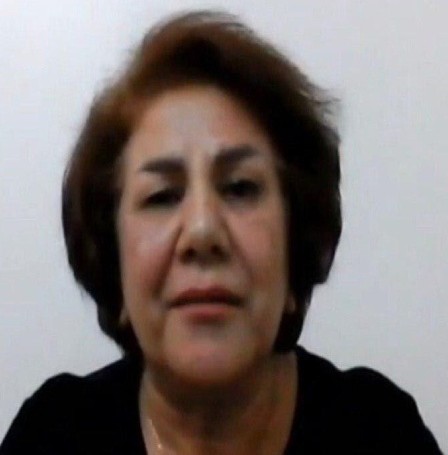
My name is Shahla Entesari, and I am a political activist and women’s rights advocate. Before the revolution, I was an active student involved in intellectual and political circles. I also collaborated with the labor movement. Due to my history of political activism, I was forced to live underground for several years after the revolution. After the 1988 mass executions and slight changes in the political climate, I gradually reconnected with my old friends and comrades to resume joint activities in the field of women’s rights.
One of the defining features of our activities was the participation of individuals from across the political spectrum, including leftists, right-leaning groups, reformists, members of the Tahkim student movement and its alumni, nationalist-religious activists, and others. All of these individuals worked together to reclaim women’s lost rights.
Initially, we held events such as International Women’s Day on March 8 in private homes and gatherings. These gatherings gradually evolved into the formation of various groups that ultimately joined forces to establish the initial framework of the women’s movement.
Establishing the Women’s Cultural Center and Organizing the March 8 Rally
In 2003, we — the same group of women who had organized March 8 gatherings in private — decided to establish an association under the name “Women’s Cultural Center.” About 50 to 60 of us participated in the women's discussion sessions. After registering the organization, we applied for a permit to hold a March 8 event in Laleh Park. The permit was granted, but just two hours before the event, the authorities contacted us and demanded that we cancel it, even asking us to issue a statement announcing the cancellation. We refused. Despite the obstacles, people showed up; however, government officials prevented the event from taking place and arrested several individuals.
The following year, in 2004, we applied again for a permit to hold the March 8 gathering at Laleh Park. Although the permit was initially granted, security forces occupied the site just hours before the event and prevented it from happening. Several people were arrested, and others were later summoned and had cases filed against them.
Aside from organizing public rallies, the women’s discussion sessions continued. Women of various political persuasions—from leftist to nationalist-religious and reformist circles—sat side by side. Although people did not openly declare their political affiliations, we knew one another's leanings. For the first time in Iranian history, women with different viewpoints were able to gather in a common space. Our goal was to draft a charter for women that would articulate what we rejected and clearly state what we demanded. To accomplish this, we studied women’s charters from countries such as India, Turkey, the United States, and Brazil. We formed working groups to examine the situation of women in different regions, from villages to cities. We focused on areas such as the economy, education, and violence against women. These collaborative discussions laid the foundation for many future collective initiatives.
I recall that, during a discussion meeting held in a basement in 2005, we unanimously decided not to seek permits for future gatherings. Previously, some in our group had insisted on operating within legal frameworks. However, once it became clear that the authorities would crack down on permitted gatherings as well, they agreed too. Approximately 50 to 60 women activists attended the meeting, and only one person opposed the decision. Ultimately, we decided not to apply for permits anymore, reasoning that the government showed no respect for our events, even with permits in place.
The June 12 Women’s Rights Protest
In June 2005, we organized a protest in front of the University of Tehran without requesting a permit. Despite the blocked streets, we arrived on a city bus with the help of bus company employees, got off in front of the university, sat down, and raised our placards.
Our demands were twofold: first, we demanded amendments to constitutional articles that discriminated against women, and second, we demanded that the Iranian government accede to the Convention on the Elimination of All Forms of Discrimination against Women (CEDAW).
We managed to read our statement, and people responded positively. Unfortunately, government officials smashed the windows of the vehicle that had brought us to the site and assaulted the driver.
The One Million Signatures Campaign and Expanding Grassroots Work
From our past interrogations and summonses, we noticed that interrogators always told us that we were just a handful of women and that most Iranian women did not share our views. They even mocked us, saying: "You are women who just want multiple husbands," claiming that other women did not support us.
Based on this experience, one of our women's discussion groups decided to take a new step. The goal was to prove, by gathering real signatures from ordinary people, that our demands were not limited to a few activists. Thus, the One Million Signatures Campaign was born. The campaign aimed to change discriminatory laws against women.
With the help of experienced lawyers, we created booklets that used simple language to explain discriminatory provisions in family law and other areas, including the denial of custody, divorce, travel, inheritance, and rights concerning blood money (diya).
We distributed these booklets widely, placing them in homes, tailor shops, beauty salons, stores, universities, and police stations. We collected forms with people's full names, phone numbers, and occupations — all genuine data. At the same time, we formed groups in the provinces and held workshops with 20–25 people. During each workshop, a social worker discussed violence against women, a lawyer addressed legal issues, and another activist presented the campaign. We held sessions for men and sent activists to towns and villages.
Nevertheless, the pressure intensified. I was the first person to be fired because of my involvement in the campaign. At the time, I was the director of social affairs at the Kahrizak nursing home. Soon after, a new wave of arrests, summonses, and prosecutions began.
Continuing Political Activities, Conviction, and Forced Exile
Alongside my work on women’s rights, I was one of the founders of the Union of Iranian Democrats. We believed that society needed to practice democracy before any change in the type of government could occur. For this reason, we formed the union to establish connections with activists abroad. In 2004, we traveled to Berlin for a Union of Iranian Republicans meeting. I attended with two others as representatives and received the most votes at the meeting. Upon returning to Iran, I continued to face arrests, judicial rulings, and security pressures.
My last act of activism was signing the "Statement of 14 Political Activists." After giving several interviews to foreign media without wearing the compulsory hijab, the first time I had appeared unveiled, I was arrested. This time, the IRGC Intelligence Organization carried out the arrest, and I was taken to Ward 2A of Evin Prison. I was sentenced to six years in prison.
While in prison, my health deteriorated due to chronic conditions, including high blood pressure, cancer, and having undergone heart and bowel surgeries. I experienced severe tremors in my left hand and leg. My physical condition worsened dramatically because my medications were cut off during solitary confinement. At one point, interrogators transferred me to Baqiyatallah Hospital at night because my blood pressure had reached 20. I was then granted a 40-day medical leave.
Despite this, my health remained severely deteriorated. I was banned from leaving the country and barred from financial transactions. My salary had been cut off for years. In effect, all of my civil rights had been taken away. Ultimately, I was forced to flee the country illegally. I spent two years in Turkey and, as of the winter of 2024, I have been living in Germany for about a year and a half.