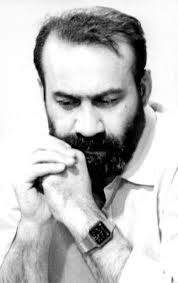
The story of the execution of Qotbzadeh is one the bitterest tales to come out of Tehran's
infamous Evin Prison between the years 1982 and 1983. But apart from that, it
also testifies to something else, and that is that even in those dark nights
there were men who disagreed with torture and killing and strongly believed in
the total abolition of capital punishment in Iran. This story and that night were
for years imprisoned in my mind. I don't know if I didn't want to, or just
couldn't, commit it to writing. Once per chance I told it to a dear friend of
mine, Naser Mohajer, and it
was upon his recommendation and with his encouragement that it finally came to
be written down. I dedicate this to him.
I just got back
from getting some air and hadn't quite yet reacclimatized when Brother Impose
yelled out: ''Eat your dinners quickly and get ready for Hosseiniye."
The person in
charge of our room, Qasem, got himself quickly to the
door and managed to get out, ''Our
room? Are you not mistaken?'' before Brother Impose banged the door in his face
and let out a long and protracted, "No!" But Qasem
wouldn't let up, ''But we," ''But and the poison of a snake!'' Brother
Impose cut him off again from behind the door. ''I said chow your feed and get
yourselves saddled for heading out to Hosseiniye, and
don't impose any further nuisance.''
As the sound of
Brother Impose's footsteps slowly faded, Qasem
shrugged his shoulders and turned to us. Mahmood was
the first to open his mouth, and while drying cold sweat off his head with a
towel said, ''I don't understand. They surely know who we are. What's up with
them this time? Tuesday nights when they're doing their Tavassol Prayers."
Hassan cut him off, ''Maybe Assadollah
has thrown another fit.''
''Man, this Brother
Impose is mistaken,'' Kazem, cool as ever entered the
discussion, ''like that other time. They'll take us there and bring us back
with a slap upside the head. Qasem, dear, you really
should have insisted.''
''Insisted how? You
wanted me to stick my foot in the door? Didn't you hear what the donkey's
offspring said?''
The whole thing was
finally brought to an end by Hassan. ''Okay then,
now, let's chow and then things will become more clear. Maybe there has been a
mistake. Or maybe we'll go and enjoy a nice Tavassol
Prayer with Assadollah. It might not be such a bad
idea.''
No one was calmed
by the joke, and on the contrary silence took over. Two months back they had
taken us to the Hosseiniye, and because of their own
mistake they had ended up really sticking it to us. It was during Ramadan, the
very day of the martyrdom of the prophet's son-in-law, Ali, to be precise. This
same Brother Impose had come in and yelled for us to feed and get saddled and
head for the Hosseiniye. That night we hadn't doubted
the Brother because there had been an increase in the volume of religious
activities for the Evin inmates, and apart from the Kamil
Prayers on Monday nights, they had opened a second broadcast channel for
God--as some of the kids liked to call it,--and had instituted the Tuesday
night Tavassol Prayers. Back then we had thought that
the call for us to be taken to the Hosseiniye had
come from Lajevardi and his program of raising the
level of discomfort and psychological pressure. No one had even considered that
the whole brilliant idea of taking the Leftists to the Hosseiniye
could have come from Brother Mustafa from whose countenance stupidity radiated
and who had come to be referred to as Brother Impose by the inmates because of
his abuse and misuse of the phrase ''do not impose nuisance.'' So, we had just
followed the orders of the Brother and had gone to the Hosseiniye.
I remember it was
packed. Brother Impose took us together with some other kids from different
cells in Section III and sat us right in front of the stage. The news that the
program for that evening was the ''Gili-Show'' put
smiles on everyone's faces. Ayatollah Gilani was
conducting a lamenting ritual and kids were laughing. But it wasn't until the
chuckles turned into belly aching hearty laughs that it quickly became clear
that we were from the Infidels' Section. From the Hosseiniye
all the way back to the prison they kicked and punched us nonstop. From then on
we had been ''Hosseiniye-Forbidden.'' On top of that,
as punishment, fresh air and warm food were denied us for one whole week. Rumor
had it that Brother Impose had also been punished for his recklessness.
This time, after
the chow and while having tea, we decided to continue our questioning and
refuse to go to Hosseiniye until it was made
absolutely clear to us that there had been no mistake. We hadn't yet finished
our tea when the door opened and the figure of Hajjaqa
Sa'id appeared in the frame. Where was Brother
Impose? How had we earned the privilege of having the Hajjaqa
order us around in person?
''It's your turn
for the toilets,'' said Hajjaqa Sa'id,
who was a few years older than Brother Impose and a bit more reasonable to talk
to. ''By the time I get back you should be ready to go. Leave the dirty dishes
for tomorrow.'' Qassem let him know about our
misgivings. ''Don't worry, there is no mistake.'' Hajjaqa
addressed our doubts and forebodings directly, ''the first part of tonight's
program is meant especially for you,'' stretching out the ''especially for
you.'' Now we really wondered what was going on. This question we took with us
to the toilets and after that to the Hosseiniye. As
we passed by the other cellblocks on our way out of the prison, the whole
Section appeared to be empty. Apparently they had taken all of Section III.
We were the last
group to enter the Hosseiniye. It was packed full to
the brim. They also had the ''sisters/brothers'' division up. Just like two
months ago, they put Section III right up in front of the stage. Behind us was
the second cellblock of Section II, which also consisted of Leftists. Behind
them were the ''repenters'' of Section IV and then came the whole of Section
VI. Section VI was for the repenters under twenty
years of age and their cells were so to say, minimum security.
They had divided
the Hosseiniye in two, using a curtain about a meter
off the ground. The right side was for the ''sisters,'' that is the women
prisoners. The left part was for ''brothers,'' that would be us. In the
beginning, when this Hosseiniye had just started its
operation, the curtain had been hanging from the roof, but now they had changed
it so that when we would stand up, the sisters could see us from the waist up.
We were taken in, moving parallel to the curtain. The women had already been
seated. This way the women prisoners would check us out from behind their
''complete Hejab'' veils as we walked past them one
by one. The male prisoners of course were only allowed to look straight in
front of them. They said the curtain had been lowered thus so that those women,
who had cut themselves off from their former organizations, could recognize
their old superiors, by and large men, who had turned them in. Hamid, who had been picked up accidentally and with a bunch
of other people had finally been identified using exactly this method. One of
the mothers of one of the Sisters' Sections had given him away. The next day
they had come to him for interrogation and had put him through heavy duress.
After three months when he came back from constant interrogation in the
coercion cells, he had developed an allergy to the word ''mother.'' Whenever we
wanted to play with him, we'd sing Sadeq Ahangaran's ''Mother You Weren't There to See.''
Speaking was
forbidden in the Hosseiniye. Only people of the same
cellblock could converse a bit, as they were seated in a row. And sometimes
when the guards who were leaning against the walls weren't paying attention, we
could exchange a word or two with those behind or in front of us; that is, if
we knew who they were. These conversations would for the most part circle
around the news of the prison: How many of you are there? What freedoms do you
have? Has anyone in your group been executed? From what groups have they been
arresting lately? How is it in the courts? How are the sentences they are
passing? Etc.
The make up of the Hosseiniye that night was easy to see. The majority of kids
were Leftists, except for the Sections IV, VI, and one cellblock in Section I.
The majority of men were from the so-called closed cells for non-repenters.
Some of the ones with balcony seating were from the solitaries from 209. The
Leftist kids sitting up front were responding half-heartedly (as Lajevardi liked to say) to the calls for ''Allah-Akbar'' emanating from the Section VI'ers
behind them. Some wouldn't answer at all. The answer to the calls for ''Allah-Akbar'' in prison differed slightly from those that had
become standard on the outside. After repeating Allah-Akbar
three times, usually on the outside, one would follow with, ''Death to the
opponents of the Velayate Faqih,'' ''Death to America,'' ''Death to Israel,'' ''Death to the splinters,'' ''Death to Saddam (Yazid)'' and ''Death to the infidels,'' and basically that
was it. On the inside in Evin, however, included on the death-list were not
only the Soviets and various armed resistance groups but also whoever else was
in the news on any particular day.
Next, the
intensification of calls for Allah-Akbar drew attention
to the fact that someone important had entered the Hosseiniye.
Who? We wouldn't be able to tell until the procession passed right by us. First
came the gorillas escorting Lajevardi,
he in the middle of them, followed by a disheveled character in a wrinkled
light-blue suit pulled by two guards. As they got closer to the stage, Lajevardi sat in his usual place on the stairs leading up
to the stage, and his entourage took their place beside him. First he looked
over the masses in front of him for a few moments before grabbing the
microphone and starting his usual praise of Allah for supporting the nameless
army of the Imam of Time, the savior to come, and also for helping to defeat
the enemies of Islam and foiling the plots of America and others against it, etc. Then he finally got to the
program of the evening.
''Tonight someone
wants to speak with you who in the beginnings of the revolution had appeared as
a friend of the revolution and the Imam. But it was the vigilance of the Imam
himself that diffused his hidden evil plot, like all the other ones before it.
For this person who had managed to penetrate the ranks is in fact an agent of
world imperialism and America. Listen carefully to his words; there are many lessons for
the rest of you in what he has to say.'' And once again he brought his remarks
to an end with a quote from a verse of the Qur'an, (Yas
Sura): ''Because the majority of them will not find
faith, the promise of pain upon them became a necessity and an
inevitability.'' Then he turned to the man in the wrinkled light-blue
suit, ''Please, Mr. Qotbzadeh!''
The Hosseiniye exploded with rhythmic chants of ''death to America, death to America.'' We all, repenters and non-repenters, Socialists,
Communists and Mojaheds, were chanting in unison. The
Hosseiniye was shaking. The man in light blue got up.
Much thinner, more broken and bent, and older than I remembered him, but it was
he, Sadeq Qotbzadeh. Maybe
it was his white stubbles or the way he slowly moved towards the stage that
made him appear so old. He reached out to grab the
microphone from Lajevardi. ''No, please, '' said the
latter sarcastically, ''won't you step up the pew? Allah be praised, you are an
excellent preacher. Step up, step up!''
Qotbzadeh went up the stairs and sat on a cheap folding chair that
was put there. He was trying not to make any direct eye contact with the
excited and united mass in front of him. The ones with balcony seats were
shaking their tight fists and continuing their passionate calls for death to America. The kids in our section started up again as well. The
passion in our midst made me think of the May Day demonstration of 1980. Then
all of a sudden my eyes skipped from Qotbzadeh to Lajevardi with his victorious smile designed to cut us down
to size. After a little while, he raised his hand to signal for quiet. The Hosseiniye was silenced. Then Lajevardi's
slight head-signal caused Qotbzadeh to speak. After a
very intensely pronounced ''in the name of Allah'' in Arabic, however, he fell
silent again. He didn't seem to know what to say. Then slowly he opened up his
mouth again and began slowly to list his services to the Imam and the
revolution. Losing the right path could happen to anyone, he said. However, he
said it in a way to avoid including himself in this ''anyone'' as best as he
could. He was all over the place, speaking about his role in the victory of the
revolution and the first days after the collapse of the Shah's order,
emphasizing again and again that he was not a wolf in sheep's clothing. But
there was no central point to his rant. It was as if he were really thinking
about something else, extending his words and sentences with his French euh-s to give him time to think. Eventually Lajevardi realized that he needed to ask more direct
questions and cut Qotbzadeh off. He began asking
about the affair of the failed coup d'etat that Qotbzadeh had apparently been a part of, and about the role
of counter-revolutionary officers in the army together with Ayatollah Shariatmadari in it. With a face full of pain, Qotbzadeh tried his best to avoid as much as he could,
occasionally saying things like ''Hajjaqa, you know
the answer to this question better than I do,'' only to be countered by Hajjaqa's ''yes, indeed, but please say it for everyone to
hear.''
But Lajevardi's questions were also scattered and without a
clear axiom. He would jump from asking about Qotbzadeh's
relationship with Ayatollah Shariatmadari to grilling
him on his experience in the resistance to the Shah.
''Please do tell us
about your background in the resistance,'' he'd ask in a tone that would crack
the audience up.
''Well, after the
1953 coup, the Religious-Nationalists sent me abroad to organize the movements
there.''
''And what did you
do?''
''The first thing
was the bringing together of various forces. Then there needed to be a
structuring of the various Islamic groups."
But Lajevardi wouldn't let him finish, as if he was bent on
destroying the little concentration that he seemed at times to muster. ''They
say you have tens of passports. Is that true?''
''Not exactly tens,
but I did have a few passports that were given to me by some third-world
countries."
''Third-world
countries?''
''Yes,
like Syria and Libya.
I even went to Palestine. That is, before the creation of the Al Fatah organization."
''This is
interesting; next you'll tell us that you have organized Yassir
Arafat as well. Of course with the shape he is in right now, it might not be
too far from the truth. But Mr. Qotbzadeh, only for
tonight, please turn to God and stick to the truth.''
''I have said these
things many times, and in the beginning of the revolution in many of the
newspapers."
''Well back then,
you would just say whatever you felt like. But now that you have repented, it
is a different story, isn't that so?''
Qotbzadeh waited a bit and continued with a sigh, ''In any case,
back then there wasn't yet anything like an Islamic Student Association of
America."
''I said stick to
your own problems. Is it not true that these passports were provided for you by
the CIA and the Americans? Your trips were also with the purpose of
infiltrating the Islamic movements, isn't this a fact? The CIA knew from the
very beginning that one day the Imam would come to power. That is why they had
recruited some to."
''Hajjaqa, I am talking about a time when the Imam had not
been exiled yet!''
''Okay then, why
didn't you come to Iran to help with our struggle?''
''I tried to come
several times, but the Imam did not grant me permission.''
''When did the Imam
not grant you permission?''
''Once I had an
audience in Najaf, and once I visited him in Paris.''
''But this must
have been recently.''
''No,
not towards the end, but in the beginning when I would send my analysis to Iran, and the tide was turning for us. I had estimated the development the events correctly. I
remember that early in 1979 I was sitting in a Cafe around the Trocadero in Paris, at around two in the morning, one of
these Leftist types who would later call me collaborationist turned to me and said,
'Mr. Qotbzadeh, don't go so fast."
''He must have been
talking about your alcohol consumption, not the Islamic revolution?''
''No, he was
talking about taking things step by step, but I disagreed, because I was a
revolutionary.''
''Is that the
reason why you wanted to destroy the center of the revolution?''
Here Lajevardi started telling a story about a house that Qotbzadeh and his cohorts had rented close to the residence
of the Imam, the ''Jamaran," and about their
plot to launch rockets into the ''center of the revolution'' from there. Qotbzadeh denied the story but did say that his goal had
been to take power, that is he wanted the government
of the time to collapse. Lajevardi again brought up
the story about a rocket attack on the Jamaran and
insisted that this had been a major step in the attempted coup d'etat. Qotbzadeh showed ever
less interest in pursuing this debate and finally surrendered: ''Yes, it was
so.''
''Rain flowers on Jamaran, rain bullets on Qotbzadeh,''
this new spontaneous chant was coming from the Section VI'ers.
The rows in front picked up on it and repeated it several times but changed
quickly to "death to America.'' The Section VI'ers didn't
follow suit and started chanting their own slogan with
ever more determination. The ones in the front rows who had found an occasion
to show the eternal truth in their old slogans started ripping their throats to
''death to America.'' The schizophrenic voices tried to silence one another
from different sides, but since there were fewer repenters tonight in the Hosseiniye, ''death to America'' finally dominated. Now Lajevardi
finally lost his patience and shouted onto the front rows, ''You think you are
in front of the university and old Qotbzadeh is gonna broadcast your meetings? Although you seem to be
Russians, deep inside you are really Americans. It is not necessary for you to
chant anymore.'' Then he fixed his hate-filled glance onto the balconies for a
few moments and sat back down. The ''death to the Soviets'' of the Section VI'ers echoed once again throughout the Hosseiniye.
The front rows had sealed their lips in silence. A bit later the Section VI'ers also quieted down. Lajevardi
continued the Q and A with Qotbzadeh. This time in
the breaks between questions and answers only the Section VI'ers
would call for ''Allah-Akbar.'' The front rows would
only join in for the ''death to America.'' And the bit about ''Khomeini, our leader,'' would also
get repeated now and again. But the rest of the slogans wouldn't be picked up,
and if so, only under their breath. But in any case, there were no ''death to
the Soviets.''
Next Lajevardi started again with questions about Qotbzadeh's connection with America and the CIA. I don't know anymore what he answered, if he
denied the connection or agreed to it. The scattered nature of his responses
had multiplied. I think he mentioned someone named Abbassi.
Lajevardi was getting more and more worked up. I am
not sure if this was because our kids kept interrupting with ''death to America'' or if it was the case that Qotbzadeh's
responses were inconsistent with his previous testimony. The Ayatollah kept
getting more and more belligerent. He was obsessed with Qotbzadeh
and the CIA. Qotbzadeh repeated several times that as
a foreign minister after the victory of the revolution, it was clear that in
one way or another he had had to deal with Americans and to have a ''relation''
of sorts with them. But he denied that the relations were what Assadollah Lajevardi had in mind.
Then all of a sudden a voice from the front rows disrupted the atmosphere
again: ''The American spy must be executed.'' Everyone repeated this one. Hands
were fisted, and tight fists were violently attempting to crack the air with
all the force and pathos they could muster. They weren't answering the Allah-Akbar calls; they were just yelling ''death to America'' with all they had.
My heart was
pounding fast. I couldn't hear anything anymore. Was this out of excitement? I
had never seen this many smiles in Evin. I could even sense the smiles of those
sitting behind me. But maybe it was out of fear that my heart was pounding. Why
fear? No, it was definitely excitement. But every time I would hear, "must
be executed,'' my whole stomach would fall. The repenters were screaming, ''Qotbzadeh to the firing squad,'' with such hatred that one
knew if they were there right now, they wouldn't have even a moment's
hesitation about pulling the trigger themselves. I recalled hearing the sound
of ''the emptying of iron'' behind Section IV. I remembered the nights of
farewell with those about to be executed; I remembered sleepless nights of
counting those close range final shots after the firing squad was done. No, the
beating of my heart was out of fear. But fear of whom?
of what? The fear that had been with me from the
moment I had entered Evin. No, but this was a different kind of fear. I didn't
realize that night why I was so scared, but every time the calls, "must be
executed,'' would get louder, my heart would also get louder, echoing in my ear
and drowning out the other voices. I hyperventilated. The sound of my heart was
filling all of the Hosseiniye.
"Mr. Qotbzadeh, if you have something else to say, say it now, wa'allah hamh aqfra
al mo'menin!"
Qotbzadeh was silent for a few moments, then
finally said: ''No, I don't have anything to say.'' But then he started
reciting a prayer of release from bondage that is related to the daughter of
the prophet, Fatemeh Zahra. He was reciting the
prayer in Persian: ''O hearer of all songs, retriever of that which is lost, O
creator of souls, give to all the faithful, woman and man, of east or west,
freedom from captivity.''
As he quieted, the
slogans, ''Death to America,'' ''American spy must be executed,'' and ''Rain on Jamaran with flowers, rain on Qotbzadeh
with bullets'' shook the Hosseiniye once again. The
slogans were intertwined with one another. Then the repenters got up and
started yelling, ''Death to the communists.'' And it wasn't until Lajevardi had picked up the microphone again that the
chants slowly died down and some sort of calm was restored. He went on with his
usual resentment-filled tone about the leadership of the Imam of the 'Umma and the victory of Islam over the infidels and asked
the ''great God'' to take the likes of us (the infidels) away from the face of
the earth. Then the outing for us came to an end when he ordered all of us to
be taken back to our cells, apart from Sections IV and VI, who would stay and
take part in the Tavassol Prayer.
We got up, queued
up, and started moving row after row with the signals from the guards. The
repenters were all up and chanting, the same way the Hezbollahis
would line up in front of the university and chant after the meetings of the
Leftist groups. But this time, as we would pass them, along the curtain where
the guards were standing disinterested, they would actually try to attack us.
Their tight fists were shaking in front of our faces. They even beat up several
of us. The guards were laughing. But as I was beginning to realize what the
purpose of this promenade along the curtain had been all along, a heavy hand
landed on my head driving home the point. It was Morteza
Naqqash, the leader of the repenters from my previous
cellblock. I increased my speed. Faramarz and Mansur were also standing right next to him. With blood red faces and from the bottom of their hearts they were
screaming, ''Death to the communists.''
I got back to the
cellblock. I was completely distraught because of the beating I had received.
The majority, however, were happy and up. Several suggested celebrating, but it
was late. We just made tea, smoked cigarettes, and got ready for bed. As I was
pulling the blanket over myself, Mansur grabbed a
piece of it, ''You're down, huh?'' He tried to engage me in a conversation.
''Forget it. The real punch was delivered by Assadollah.
He hit all of us upside the head. And he hit us in away that we didn't even
realize we were being hit.'' I didn't get his point but didn't feel like
talking anyway. The guards turned the lights out, and the room was only lit by
the little red night-lamp that we ourselves had made.
I don't know when I
fell asleep, or if I slept at all, but I couldn't get the repenters at the Hosseiniye out of my mind. I had turned into Qotbzadeh. With the same broken and old face. I was seeing Lajevardi and hearing his voice as well. It was echoing in
my head like the final close-range shots after the firing squad was done behind
Section IV. ''We will destroy you all!'' Then it was my turn to remember my own
interrogation.
I was coming back from
my last session of intense interrogation in the basement of the solitary units.
After getting back to the regular interrogation room, Hosseini
had put a paper in front of me. ''Sign this sworn statement and we'll free
you,'' he had said.
Without any resistance,
or even reading what I was signing, I had taken the pen and signed. Only
afterwards I began reading it. ''I declare my absolute rejection of the
organizations." I had thought that everything would be over with this
signature, but I was sent to the basement again, and after spending a few days
there, they called me up again. ''This affidavit is not enough,''
Hosseini began as soon as I walked in. ''I have
spoken with the Shari'a magistrate. You have a lot
more information. On top of that, you haven't repented and don't even pray.
Don't think that you have fooled us with this piece of paper. You have to talk.
We want information.'' ''I don't have any information,'' I had said, realizing
that I was the one who had been fooled all along, ''and that confession you
have gotten out of me has been taken under duress and has no legal value. Give
it to me so I can rip it.''
Then they kicked me
out of the interrogation room again, back to the solitary. They wouldn't even
change my bandages. They held me in the solitary for a few days and then
brought me back to my usual cellblock again.
I had told the
story to the other guys. ''It's not important,'' I had disagreed with Mansur as soon as he started with this. ''It is just a
piece of paper. If they let you go with it, that is the important thing.'' It
was important for me. I shouldn't have signed at all. I had a bad feeling, I
was bitter, didn't want company, hated myself. All of
their consoling was for nothing. I couldn't accept it, most of all because I
knew that I was being fooled.
And now, this time
again, it wasn't because of the smack I had received from Morteza
that I was feeling down. It wasn't the first time that I was beaten either,
although it was the first time that a character like Morteza
would hit me. When he was in our room, he didn't even dare talk loudly. No,
something else was the matter, something more serious, something more
important, much more important. I was going back and forth on these issues,
when the guard opened the door and ordered us to get up. I was up. I couldn't
be sure if I was up all night or not.
The time for the
morning washing was the time when the prisoners were supposed to get ready for
the Morning Prayer, but they would take us to the washroom much later since we
didn't pray, between 6 and 6:30 usually.
After that we'd drink our teas and get ready for daily interrogations. Today's
breakfast discussion was a continuation of last night's. Most of the guys were
speaking positively about our adventure at the Hosseiniye
and were going on about our correct moves and the fact that we had proved
ourselves to Lajevardi. After breakfast Mansur asked if I was up for a game of chess--as the
English call it. I didn't feel like it. I was still bitter. All I wanted to do
was to crawl to some corner and curl up around my own thoughts. ''Are you
scared you'll be mated,'' he was now trying provocation as a method of finding
a playmate but before he could get under my skin Hassan
threw himself in. ''Since last night when he took a smack upside his head he
has been mated; play me.''
The chess corner
was located around the bend of the door in the corner of the room, so that the
guards wouldn't be able to see us on their periodical cursory check-ups just by
looking in. The two of them sat there and unfolded the ''board'' and started
placing buttons on it. The ''board'' consisted of the large crossword puzzle of
Zaneruz
(Today's Woman) magazine. The ''Engineer,'' one of the guys from the cellblock,
had designed it. For one whole month he had insisted on getting Zaneruz. The
block had unanimously voted against the acquiring of Zaneruz on several occasions, and
yet the Engineer would not have it, and continued his lobbying for the women's
magazine. Finally, the majority had pulled back and agreed to buy two--only
two--editions of Zaneruz.
Once we had let the guard responsible for the purchase know of our decision, he
had just looked us up and down and without hesitation had asked if we wanted to
masturbate to it.
That night
everybody was sore with the Engineer, but he was simply not acknowledging it.
And the day the guard had thrown the magazine into the room and with a smile of
satisfaction had announced to all that there were in fact no ''women'' in it, Abdollah had lost it and attacked the Engineer saying,
''Happy? Are we gonna order tampons next?'' The
Engineer had said nothing and hadn't even acknowledged there to be a problem.
On the contrary, with a victorious smile he had gone to his corner and had
started leafing through his magazine. The next week also when his magazine
arrived, he had not even come out for our daily ration of fresh air. Even when
he had asked for scotch-tape we didn't pick up on the clues. But as soon as we
had come back in, he had greeted us with a meaningful smirk on his face:
''Whose up for Shatranj?" he asked.
We were completely
taken aback with the chess-set; the wisdom and the necessity of ordering the
women's magazine was slowly dawning on us. The crossword in Zaneruz
was the biggest in all the magazines and the Engineer had stacked the little
squares from two different puzzles together to create a decent chessboard. The
genius of the masterpiece prevented anyone from complaining about the use of
their buttons, which for some time had been missing. We did have to go through
a special training, however, to be able to use the Engineer's ''chess,'' as he
called it. Later on he would tell us that he had thought about the idea for
three months while in the solitary in 209.
Today, as usual, Mansur would take the black buttons in order ''to give an
advantage'' to his opponents, kindly. I sat right in front of the door so that
no guard could just run in. This would also allow me to observe the game from
relatively close by. Khosrow, with whom Mansur and I always shared the same cigarette, lit one up
and came next to me to distribute the daily ration.
''You're still sour
kid? If it's because of last night, it wasn't your first time, was it?''
''I swear to you Khosrow, brother, I've been telling him the same. Don't
spoil all the fun we had last night. But he won't listen. Just between us,
though, wasn't it fun last night?'' It was Hassan
again, barging in.
He got his answer
from Khosrow promptly: ''What fun, Mr. Hassan? Like cows they took us there to scream for them.''
''Come on, Khosrow, brother, all that 'death to America' and not answering the calls from the repenters' sides and
getting under Assadollah's skin? That's not being
like cows.''
''Not at all,''
said Mansur advancing with a pawn, ''that's not being
cows, it is advancing the cause of the struggle against imperialism deep in the
theater of blessed Hajjaqa Assadollah
Lajevardi's Hosseiniye.''
''In my opinion,''
said Kazem who was watching the game from behind Hassan's back, ''the importance of last night was not the
chanting of 'death to America'; rather, it was the coming about of a sort of
unity amongst the Leftist kids. For the first time we stood
up to Assadollah and put the repenters in their
place.''
''And what about Qotbzadeh in all this?'' said Khosrow
exhaling a lung full of smoke. ''It didn't really matter to him either way, did
it? From his perspective you'd see that last night the Hosseiniye
was full of repenters who were all shouting death to this, that, and the other
thing in unison.''
''Khosrow, are you now defending Qotbzadeh
all of a sudden?''
''I said we stuck
it to Assadollah,'' Kazem
interjected before Khosrow could respond, ''but you
know, they say that the yellow dog is the cousin of the Jackal.''
''No, Kazem, my dear, the yellow dog, when in prison, is called
the prisoner,'' Mansur stalled a short moment on the
word ''prisoner,'' was quiet for a bit, and then moved his queen into Hassan's territory continuing, ''even if he were the
brother of the Jackal, he is still different from us, because he is not sheep;
he is of a different material. But in any, case whatever he may be, he is first
and foremost a prisoner, check!'' And before we could assess the developments
on the board, he continued, ''I don't know what your opinion is, but if you
think that Assadollah has taken us to the Hosseiniye in order to show the dear Leftists that they too
have the power to stick together and even there get loud and rowdy and conduct
anti-imperialist maneuvers, you are mistaken. Assadollah
took us there to put another prisoner in front of us, have us go at him, and
prove to us that the difference between us and the Section VI'ers
is only in two slogans. That's all.''
"Mansur Khan, of all people, why do you say such things? The
issue last night was not 'death to America,' in truth it was 'death to Assadollah.'
'Death to America' was merely a medium in which we could show our existence.
Proving once again what we have always maintained and that is that Qotbzadeh, Yazdi, Bani-Sadr, and the rest of them are all Americans. Hadn't
we said that before? It was we who first had come up with
'death to world imperialism with the leadership of the American
imperialism,' have you forgotten that?"
''Actually it was
'death to America and its native servants,''' clarified Kazem
before Hassan could go any further, ''and that means,
death to the defeated counter-revolutionaries as well as the ruling
counter-revolutionaries.''
''And
now what?'' Khosrow
had decided to light another one using my cigarette butt, and he took a drag
before letting it go around. ''Is that supposed to mean that your grace and my
humble being were in place of the magistrate of the Shari'a
last night and were reviewing the correctness of the claims and the projections
of various Leftist groups? Or was there perhaps a people's court set up in the Hosseiniye last night and we didn't know about it? It seems
that you guys have forgotten who you are and why you are here. It seems like
you don't want to understand that.''
''What are we
supposed to understand? 'Death to America and its native servants' includes all of them, from he who
is a new prisoner now, to the Shari'a magistrate, to Assadollah himself. Khosrow,
dear, think for a moment! Wasn't this very character you are defending now, who
led you-know-who down from the stairs of Air France that day? Didn't he become the foreign minister, and the
head of state television, and the friend of Ms. Zahra from the front of the
university? Wasn't it he who took the newly freed radio and television from
those on strike and gave it to this same Assadollah
and the other motherfucker? No, the 'death to America' of last night was no ordinary 'death to America.' And this is not a difficult thing to understand. Even Assadollah himself had realized it. That's why he was so
pissed off. It was death to Assadollah and this
criminal repenter-making machine, in the creation of
which Mr. Qotbzadeh himself has played a role?"
''Kazem, dear, listen,'' started Mansur
while taking his dead horse from Hassan's field, ''I
agree with everything you are saying.'' Then he took a giant drag from the butt
Khosrow had handed him and continued, ''But please
say a few words about us. What did we do last night? We went to Assadollah's Hosseiniye,
participated in the mental torturing of another prisoner, and screamed that he
'must be executed.' Qotbzadeh and whatever he has
done remains the same. But what about us? We are
ourselves in chains. We are prisoners in this, as you say, criminal system.
Now, after everything that they have done to us, and the life they have
extracted from us, we go and sing to the tune of this very same Assadollah and you call this embarrassment the 'struggle
against Assadollah, imperialism, counter-revolution,'
or whatever else?"
''We are united
with them in this very same thing you call 'whatever else','' Hassan was bent on cutting diminishing? Mansur's
words and had found a place to do so.
''You
and them are united in this, not we and
them,'' Kazem disappointed Hassan.
''This matter has nothing to do with us. Your defense of the line of Sir
Ruhollah and Sir Assadollah has nothing to do with
us.'' But he wouldn't stop there, now he turned to Mansur
and continued, ''Mansur, dear, I am not speaking of
that anti-imperialist struggle that Hassan is talking
about and says continues even in the bowls of Evin. I have another
understanding of this struggle the discussion of which is too far a field here.
However, I still don't understand why we should feel sorry for Qotbzadeh and not ask for his execution and not scream for
its implementation.''
''You see Kazem, dear, this is not a matter
of sympathy for Qotbzadeh. In this hell-hole, with
all the torture, the executions, the daily belittling and dehumanizing
atmosphere, the first and foremost thing to keep in mind is the complete
rejection of the idea of imprisoning, torture, and execution of a human being
because of a political idea. But instead of disagreeing with the whole of this
criminal system, we are only saying, don't bother us, don't imprison us, don't
execute us. It's the story of our very own flower of a person, Mr. Hassan, who even today gives out leaflets saying, 'Free
members of the Tudeh Party'; that is to say, all the
rest can be sacrificed to the left testicle of the horse of his majesty, the
secretary general of the Tudeh Communist Party, Mr. Kianouri!"
Hassan's face was wrinkled. He wanted to say something as an answer
to Khosrow, but before he could regroup, Kazem came to his rescue: ''But Khosrow,
dear, what you say only applied to those cases overseas. You know that I am in
place of your servant and don't want to get into a debate and disagreement with
you about what kinds of influences you were under in those Euro-Communists
countries and what kinds of things you were saying in those days of the famous
Confederation of Iranian Students. But, my very dearest, the banning of torture
and capital punishment is good for places like France, Germany, or America, not for places like Iran and Afghanistan."
''Gentlemen please
excuse my intrusion,'' the self-proclaimed judge of all chess games, the
otherwise absolutely quiet Engineer who would never take his eyes even for a
split second off of a game in progress, finally began to speak, ''but are you
suggesting that the heroic Iranian folk are not human, but rather cows in need
of impaling in order for them to be able to tell the difference between the
road and the hole in it? Well, if that is what needs to be done, masters, Sir Assadollah is doing an excellent job, and once his work is
done, there will be no heads left for the red ax to chop.''
As the Engineer was
talking, Hassan was shaking his head and finally, as
if he had discovered something that had to be shared with the rest of us
immediately, started his reasoning thus: ''First I must explain one thing,
after that I have a question for all of you. First of all, it is not only the Tudeh Party that demands the release of their own people.
All groups are only concerned with their own. But the question is: let's
imagine that we, here, were to come to power, not through the Tudeh Party, but with any organization that we all could
agree with. It is clear that in that instant, a group of anti-revolutionaries
will declare war on our government and will try to take power away from us. But
the power is still in our hands, and ours is a revolutionary government. Okay,
what will we do? Will we not arrest? Will we not imprison? Will we not execute?
And let's imagine that this anti-revolutionary opposition will then attempt to
assassinate our leadership. What would we do? Let's imagine Bijan
Jazani. Let's imagine he were alive now and would be
our president, and the counter-revolutionaries had cooked up plans to kill him.
Let's imagine that through all sorts of troubles we had managed to detain one of
them, but he had resisted and not given us information. What would we do? Time
is tight. The life of Bijan is in danger. Would we
not torture? Would we say that torture is inhuman and would we thereby not give
up all hope of stopping the killing of Bijan Jazani? Huh?''
Hassan had presented his argument and was sure to have shown the
contradiction in the reasoning of his opponents. There was a short silence.
''Hassan, don't you, who counts execution shots behind
Section IV at night, disgust yourself by implying that we would do the very
same thing?'' Mansur was the one who had broken the
silence. ''We? Who are we? You think it is because of
bad luck that we are not guards, but prisoners. No, my dear Hassan,
I think it is only your view that manages to misinterpret things in this way.''
Kazem cut off Mansur and turned to Hassan: ''In my opinion it is your line that explains
things in this way.''
''Kazem, there is no 'my view' and 'your view'. The main
point is that counter-revolution needs to be suppressed. You and I agree on
this point. You may say that the anti-revolution includes the profiteering
minority and the national bourgeoisies, and I may say that the toiling majority
in the cities and villages and so and so nationalists' forces are also a part
of the revolution. But I doubt that we disagree on the fact that the
anti-revolutionary force must be answered by revolutionary force.''
''But if one day I
become convinced that I have no choice but to turn into an Assadollah,
that day, I'd put the struggle aside. The revolutionary struggle is not worth
committing crimes and murders.''
'You call the
suppression of the anti-revolutionary forces a crime? Answer the question
please!'
''I don't
understand what your point is. You mix everything up: the revolutionary
government and Bijan Jazani
and the Islamic government and Imam Khomeini, and the government of the toiling
majority.But if one day I turn into Assadollah, forget about the working class, I couldn't then
even save myself from filth and crime. The government of the working class
ought not be the same as the government of the
executioner.''
''So
what about the revolutionary vengeance and Lenin's red terror? If that's what you're saying, then you disagree with the
whole idea of a socialist revolution.''
''Man, you've mixed
everything up again. What's the relationship between the red terror and torture
and execution? The difference between Assadollah and
me is very simple and clear. I fight for humanity and for a better tomorrow for
all mankind. And that is why I say I don't accept caning and execution and Assadollah. On top of that, someone who is sitting in
Section III of Evin, and on the cutting edge of the blade of the executioner,
shouldn't ask for someone else to be slaughtered.''
''My dear Khosrow, I don't have anything to do with what Hassan argues, I am saying something else, and that is that
you only see the ruling anti-revolutionaries. If Assadollah
is the victorious counter-revolutionary, then Qotbzadeh
is the defeated counter-revolutionary. And their fight is that between two
wolves. And it does not matter to me which one of them ends up ripping the
belly of the other.''
''Counter-revolution? Well, for the time being, we are all here counter-revolutionaries.
And even in this room, some of the others and myself
are, according to the line of Hassan,
counter-revolutionaries. Hassan and those of his line
are counter-revolutionaries to you. And for Mansur
all the rest of us together are counter-revolutionaries. And
finally for Assadollah?''
''Instead of Kazem's question, please answer mine. I'll ask it again: is
it not the case that in all governments the sentence for an anti-revolutionary
is death?''
''Quit it, Hassan. Have you ever realized that you are in Evin? Day
and night, the whole universe--Assadollah, Hamed, Rahimi, the office of
public prosecutors, and the headquarters of Imam--all have joined forces to
create beasts out of us. Have you ever thought how one can resist all this,
when you yourself want to be Assadollah and pull the
trigger? Choose whatever revolution you want and quote 'facts'--as the English
say-- from Lenin and the God almighty himself if you want. We are not talking
about potatoes here. Why do you use Assadollah's
language?''
Everyone was
suddenly looking at me. Even I didn't know why I was suddenly in the middle of
this debate. But Kazem didn't want to change the
atmosphere of the discussion.
''No! We have
revolutions and then we have revolutions. And the counter-revolutionaries are
also not all the same. We are different from the counter-revolutionaries who
were part of the previous regime or collaborated with Sir Assadollah
and his lot. Our revolution has its own characteristics. These masters, even
back then when they were in the Shah's prisons, were already lost and so to say
condemned, and nothing has changed now that they are judges and prosecutors.
They were always wrong and anti-revolution. They even were jealous of our
resistance in the Shah's prisons and harbored resentments against us, because
they weren't resistant themselves. But we are different. And our revolution is
different.''
''No Kazem, dear, in my opinion a revolution is a revolution. In
every place and every time, it works according to the same mechanism. The thing
that differs is what happens after the revolution. That is where the
differences manifest themselves.''
''But Mr. Hassan, I think the differences are there from the very
beginning. Isn't it true that this same Assadollah
was a prisoner? Didn't he resist? Wasn't he for the revolution? But he was
plotting the same things for Arash and Rassuli. It started with them, and now it's our turn. That
is why Tehrani wrote letters for them. He knew them
very well. And for this very reason Assadollah took
us last night and sat us up front. And we shared our voices with the Hezbollahis. Everyone judge according to your own
conscience. And the whole thing about who is the enemy and who is the victor
and who is the defeated cannot drag us into screaming for the execution of
others. You think you have shown Assadollah and his
repenters a thing or two last night? I say, like usual, it was we who were
caught in their trap.''
As Mansur finished his speech and turned his face toward the
chessboard, Hassan moved his queen forward and said
''Checkmate.''
With the start of
the program, ''the Visage of Martyr Katchui,'' that
was shown everyday between the hours of ten and twelve in the morning on Evin's
closed circuit TV, we all sat in our places facing the TV. Although no one
cared for the program, and we had turned the volume down so that we could do
our own thing, we had to appear to be watching it or the guards would let us
have it. The announcer listed the program for today: the political lessons of
the teacher of ethics, Martyr Bahonar, followed by a
speech by Haddad-Adel about religion and ideology.
I didn't move. I
just rested my head against the door and reviewed the words of Hassan in my head. My heart started up again. I had never
thought of it this way. From my very first day in prison when I was woken up
with the sound of machine guns, the thought of torture and execution wouldn't
leave me alone. When I would be put under duress, I would say to myself if I
thought about revenge, it all wouldn't hurt as much. I would look at my
bandaged feet and think about what I would do if one day Hamed
and Fakur and Rahimi fell
into my lap. With the thin cable that would peel a part of skin with each hit,
or with cable 14 that neither gives immediate blisters nor lesions, but each
hit of which turns all the joints in the body into bayonets that storm other
joints, hits to the bottom of the feet that turn the neck into a spear
penetrating the brains within the skull. I also fantasized about their
execution. After waking out of each nightmare I would say to myself, my turn
will also come one day. I would press my fingers deep into my ears in order not
to hear the guns and lie to myself that no one was killed that day. The smiles
of new friends would stay behind on the walls, on the beds, behind the painted
windows. But they would be cold and lifeless. The reflex of facial muscles was
what was responsible for them. They weren't smiles. They were faces of
helplessness and destitution. And these smiles would not go away like those of
a hero in a book one could close, but stayed in the room, both on the walls of
the cell and on the walls inside my head. It wasn't book-like or heroic; they
would just go towards their deaths without quite knowing why. And yet they were
heroes because they knew that together with saying no comes death. But maybe
they didn't know that death would come so soon, in the evening of the very same
day, moments after drinking their last cup of water, directly after their last
game of football while getting their ration of fresh air, or after the last
recounting of the memories of their time on the outside of prison walls. And as
they went, they didn't know that their smiles would remain behind and, at
nights, under the blanket, would mix with our tears and would be replaced by
another smile on the very next day.
Smiles and thinking
about them gave me a peculiar feeling. I don't know what kind of feeling, but
after that whenever I would hear ''must be executed,'' my heart would race, and
I would take it as a reminder to go back to the remote corners of the cell and
look for them and if I found them gather them up and commit them to memory, so
that I would never find myself saying that my turn will also come one day, and
that I will also soon chain and execute smiles. No, maybe he hasn't experienced
my nightmares and hasn't lived in Section I together with repenting kids whose
neighbors had just been executed. No one has told him about Faramarz
in Section I, who had rested the G-3 on his shoulders, closed his eyes and pulled
the trigger. At night he would scream ''Ya Abn al-Hassan Ajal
al-Azhuri'' and cry. Mehran
was one of the big shots of the Mojahedin who had
been arrested in the middle of the summer of '82 and was a witness to all the
executions. I had listened to his stories. Sometimes I would think that I
myself had been there and had seen how Faramarz had
pointed the gun towards himself and splashed his face
and head full of blood. That's when Faramarz had
started being obsessive compulsive and would keep washing his hands and face
nonstop. It was as if I myself had heard a guard say to him, ''Your reward will
be delivered by the offspring of Zahra, do it.'' He had done it and had seen
the body drown in blood. Our Hassan has not heard the
story of the day when they took Mehran and other kids
and showed them the bodies of Mussa Khiyabani and Ashraf Rabi'i. I was told that nightmare that has since become my
nightmare. Maybe I myself had been there as well, I don't know. But it was
always the voice of Mehran that echoed in my ears:
''They came early
in the morning and made us queue up. They put blinders on us and moved us out
of the cell. I could see a little from the behind the blinders. First they took
us toward the Hosseiniye, and then from the fork
between the Sections they took us behind Section IV. I was scared for a moment.
I thought they were gonna do another one of their
mass executions again, like the early days. The night before it had snowed
heavily and that made it difficult to walk on the ice with our flimsy slippers.
Like usual our hands were resting on the shoulders of the one in front of us.
But we were moving much slower than usual. We were struggling along when
suddenly the person in front of me fell to the ground, and something hit my
head also. I lost my balance and fell too. I tried to get up but something else
hit my head and back, and I fell again. My hands had touched something in mid
air. I was hanging onto it. I didn't know what it was at first. Then I realized
that it was a pair of legs. The queue was in disarray. Everyone was stumbling
around like me. Then I got a glance from under my blinder and my heart stopped.
They were passing us through the hanged bodies that were just dangling there. I
saw a glimpse of a white face, with eyes popped out of their sockets. The
guards in front were laughing uncontrollably. They collected and organized us,
and we began our march again. After a little while they ordered us to stop.
Then they got us to form a big circle, and ordered us to remove the blinders.
We uncovered our eyes and saw Mussa Khiyabani, Ashraf Rabi'I, and a few others lying there on the ground. Lajevardi started a speech. He was talking about the
victory of the nameless army of the Imam of Time, the absent savior to come. As
he was going on with his usual rant, he would occasionally kick the cadavers
with the tip of his shoes. And he finished his speech with this sentence:
''Whoever is a true repenter must spit at these
cadavers as he passes them.'' I suddenly noticed my hands. They were both bloody.
When I had fallen, my hands had gotten wet. I had thought it was just ice and
snow. I slowly turned around and looked at the bodies that were hanging. Some
of them were on the ground. I couldn't tell if they had been put in front of a
firing squad or if they were from the Team House that they said had put up
armed resistance. One of them was still moving. I was sure.''
Hassan had also not heard about Hekmat
and his mock executions. They would put Hekmat
together with Davood Mada'en
and Fereydoun A'zami in
front of a firing squad three nights in a row. Each time their friends would be
killed but the three of them would be brought back to their cells. Then after a
few hours they would take them into the interrogation room. On the third night
they had executed the other two, and after that Hekmat's
hair had suddenly turned all white. No, Hassan hasn't
heard that executing is for Assadollahs. Even if they
should want to kill Bijan Jazani,
one shouldn't turn into Hamed and Assadollah
and Rahimi.
The sound of the
opening of the door broke my line of thought. A guard had brought lunch. It was
rice and yogurt. I didn't have any appetite. I was just waiting for the
cigarette after lunch. Once the lunch was cleared, cigarettes were lit. As Mansur was about to light a second one, the guard came in
and said, ''Fresh air.''
The ball players
took the ball; the rest were pacing the yard in groups of two. I didn't want to
talk to anyone. The loudspeaker in the yard started giving the two o'clock news. It was in the summary of the headlines that we
heard: ''Sadeq Qotbzadeh
was recognized by the central court of the Islamic revolution as the element of
corruption on earth and the enemy of God and was sentenced to death. The
sentence was carried out in the early hours of this morning.''
Hassan was walking toward me. ''They did him. This
very morning. Poor one.''
There was a smile
on his face. I had felt it correctly. I had been fooled again. What had I done
in the last hours of someone who had been sentenced to death? Had he known? And we?
''Yes, Hassan, they did him. This time you and I were also in the
lineup of the firing squad. You are right. If we get to power, we will also
become Assadollah. But I won't be fooled again.''
The lifeless autumn
sun was shinning its very dim rays onto the barbed wires on the walls of the
correctional facility.
_____________________________________________________________
Source : The Book of Prison, An anthology
of Prison Life in the Islamic Republic of Iran, ed. Nasser Mohajer,
Noghteh Books, 2001, Vol. 2, p.119-138.
Translated in English by AIT for ABF.